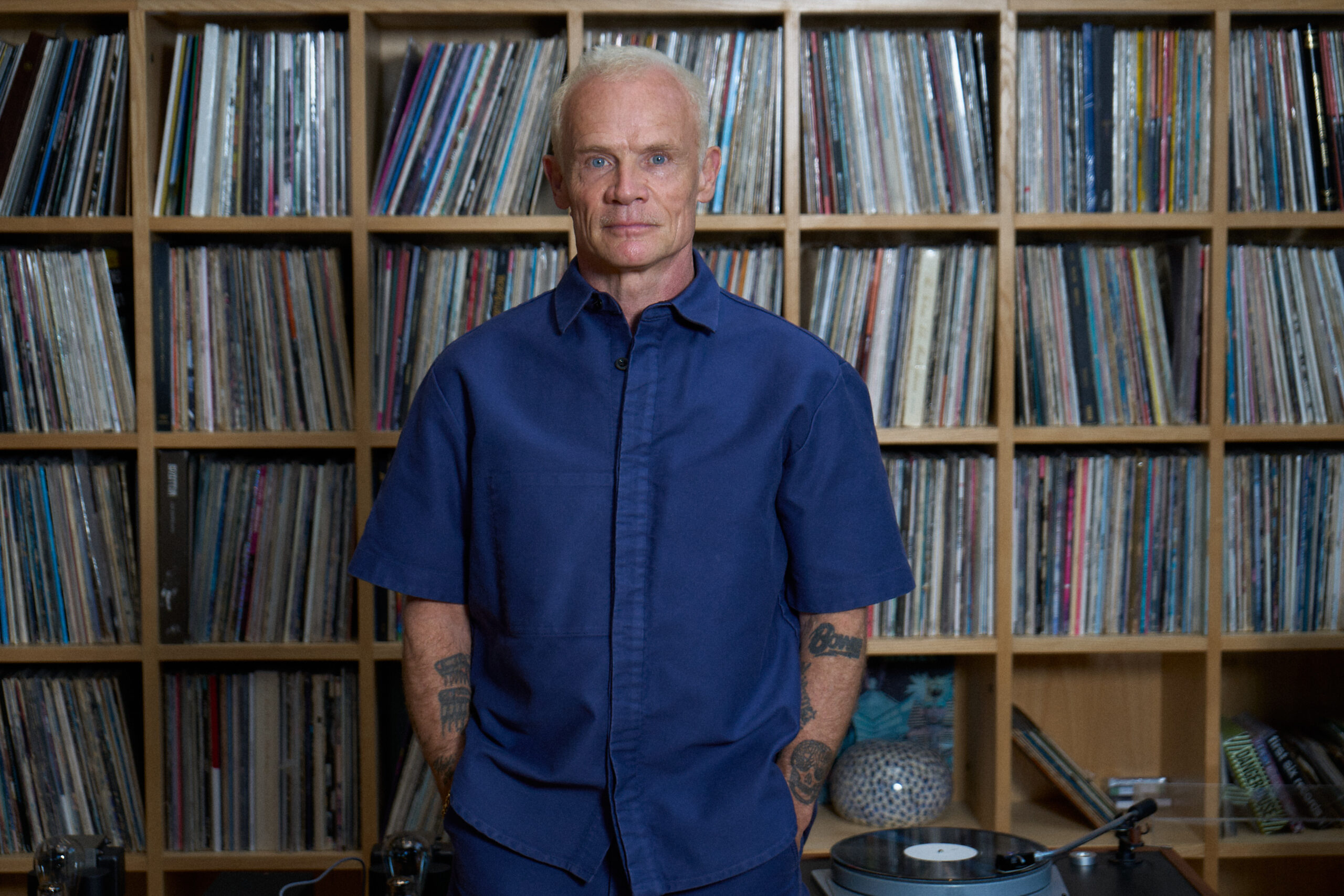
Mei Semones creates an airy, effortless blend of jazz and indie pop that makes some people feel like floating. At least, that’s how Flea would describe it. A couple of years ago, as Semones released her 2024 EP Kabutomushi, the legendary bassist took notice and evangelized the up-and-comer on social media. Calling the EP “an absolutely beautiful record” that “carries a mysterious power,” he added, “It gets me floating around my hotel room … It gives me so much hope for the young people making music today.”
“I have no idea how he found my music,” Semones admits, still grateful for the exposure. The unexpected co-sign led to a bump of 3,000 new followers in one day and people who still find her music through the recommendation. “He just DM’ed me on Instagram, and we kind of became friends from there. He came to our show in L.A. and I went to his album listening party recently [for his solo debut Honora]. He’s a really nice guy, and I’m very honored that he’s a fan because I’m a fan of what he does.”
More from Spin:
- Rock Hall Inductees: Oasis, Sade, Wu-Tang, Luther
- Summer Smash Snags Carti, Keem, Uzi, Skrillex
- No Doubt’s Tom Dumont Reveals Parkinson’s Diagnosis
It’s now two years later, and the 25-year-old is holed up in her Brooklyn apartment doing a round of press as she readies another new EP, Kurage, out April 10 on Bayonet Records. It’s not even a year after her acclaimed debut LP Animaru was released in May 2025, and the buzz around her work continues to grow. There’s even talks of her and Flea possibly collaborating at some point.
“He’s kind of loosely been like, ‘I’ll play trumpet or bass, whatever you want.’ I’ll take him up on that at some point if he’s interested in doing it,” Semones says with a nonchalant vibe that’s as zen as her music.
For now, though, she’s focused on her current crop of partners who appear on the collaborative Kurage. The list includes the British-Brazilian singer-songwriter and guitarist Liana Flores on the song “Koneko,” Brooklyn bossa nova rising star John Roseboro on “Tooth Fairy” and her own father, Don Semones, on the title track. Their handiwork and vocal duets add yet another set of layers to Semones’ fluid music style that mixes in everything from jazz to math rock to J-pop to alt rock and Latin-inspired arrangements. All of it is accompanied by bilingual lyrics that blend in English and Japanese, two languages Semones has been fluent in since she could talk.
“I like collaborating with people,” she admits, explaining more about her process. “I write the song as I’m thinking about them and making sure I’m leaving space for them, while also making a song that sounds right for their style.”
Each of the songs on Kurage are perfect examples of this kind of artistic marriage, especially when you add in the fact that each is rooted in a specific place where Semones and her collaborators have intersected. For example, the jazzy dreamscape that comes across in “Tooth Fairy”—complemented by the instrumentals of Semones’ full band that includes Noam Tanzer on bass, Ransom McCafferty on drums, Claudius Agrippa on violin, and Noah Leong on viola—was inspired by a chance run-in on a train platform in their shared home of Brooklyn.
Semones and Roseboro happened to be on the same train headed to Greenpoint. When the two friends saw each other at the station, Roseboro explained how he was on the way to see his dentist after a tooth had fallen out. “Did it hurt when you lost it? Does it hurt after it is gone? I hope the tooth fairy will give you something to make it up,” Semones sings in the lighthearted piece, an ode to friendship and living in the moment.

“Koneko” is another example—this time, also incorporating lyrics in Portuguese—that pays homage to another friendship, memorializing the time Semones visited Flores in London last April. It was also Semones’ first time in the U.K. The lilting arrangement captures the innocence of the trip, as they “walked along the canal, drank tea, ate strawberries and cookies, and played with her cat.”
For the EP’s final entry, the title track, Semones was inspired by regular family trips to her mom’s birthplace of Yokosuka, Japan. “I was thinking about when I used to go to the aquarium there when I was little,” explains Semones, adding that “kurage” translates to “jellyfish” in Japanese. Recording the song took shape in another meaningful place as Semones went back to her hometown of Ann Arbor, Michigan, where she linked up with her dad. It was their first time recording music together, though a long time coming.
“I’ve always wanted to make a piece of music with him,” Semones admits.
By day, Don Semones is a trained chemical engineer who works for an automotive supplier, but by night he plays euphonium in a local concert band. His love of music was incredibly influential for his daughter as he introduced her to the jazz and rock that perked her ear as a child. “He always had it on the radio or was playing his CDs for us,” Semones recalls. He also bought Semones her first guitar, an Epiphone Les Paul, though nowadays she can often be seen wielding her favorite model, the PRS McCarty 594.
Piano was actually her first instrument, however, thanks to a grandmother who lived vicariously through the lessons she arranged for Semones and her twin sister. “She actually didn’t play piano at all, but I think she always wanted to and just never had the opportunity. So one of the first things she did when we were really young, like 4 years old, was she bought us a piano and told us, ‘you have to take piano lessons.’”
But it only took a few years before guitar entered the picture, which can be credited to seeing the movie Back To The Future. As Semones recalls, “My parents showed it to me when I was like 10 or 11. There’s a scene where the main character, Marty, is playing a Chuck Berry song on the electric guitar, and I just thought it looked really cool and fun to play, so I wanted to try it.”

By middle school, Semones had learned enough of the instrument that she wrote her first song on guitar, admitting, “it wasn’t great.” But by high school, she became more grounded in the instrument after joining the school’s jazz band. “I figured if I can play guitar in a class at school, I might as well do it. And then I actually really ended up liking the genre and I started listening to it more and studying it,” she recalls, remembering the influence of early standards like “Autumn Leaves,” “All The Things You Are” and Miles Davis’ “So What.”
Her passion for the craft eventually led Semones to study at Berklee College of Music where, by her last semester in 2022, she already had material for her debut EP Tsukino. Released that same year, it laid the seeds of her unique style that confidently crosses borders of genre, geography, and culture.
“I think in a sense people are drawn to things that they don’t always understand,” she says, commenting on her bilingual lyrics. “Or maybe they are curious about it because they don’t know what I’m saying. But more than that, it reflects how music is a universal language. It doesn’t really matter the language; it’s more just the feeling of the music.”
That theory also can apply to the layered, genre-bending style she incorporates into each song, pulled from her other loves like J-pop, Brazilian artists Antônio Carlos Jobim, and João Gilberto and, of course, rock, going back to that first time she heard Chuck Berry. In fact, one of her favorite all-time acts is the Smashing Pumpkins, her favorite song the Mellon Collie track “Here Is No Why.”
But jazz has always been at the forefront. “I think what first drew me to it was the technical aspect, the music theory stuff. Obviously there’s so much more that goes into it, but when you’re first learning jazz, you’re learning some theory and I liked how it was challenging to me, and it still is,” Semones says, touting classic players like John Coltrane, Charlie Parker, and Thelonious Monk as heavy influences. In addition to the instrumentation, she also was inspired to try jazz singing after spending time with Chet Baker’s catalog and favoring his style of intonation. In 2025, a full-circle moment came when Semones contributed a cover of his “My Ideal” to the tribute album Chet Baker Re:imagined for Decca Records.

“As I got into jazz more, I think what I really like is how important it is to have your own voice and be recognizable as a musician and as an improviser,” she adds. “The best jazz musicians in my opinion, you know who they are, you can hear who it is, just from hearing the first few notes of their solo. In jazz it really is important to have your own voice, and that is important to me as a person and as a musician.”
Like Raye, Laufey, and Samara Joy, Semones has been influential in pushing jazz forward for a younger generation of listeners. Not only has Laufey sold out arena tours and made pivotal breakthroughs for the genre at events like Lollapalooza, but Raye and Joy have both been a contender and winner, respectively, for the Grammy’s Best New Artist category. In recent years, Spotify has also reported that up to 40% of its listeners who tune into jazz are under 40, showing a pivotal evolution in listenership. Semones is happy to see her fellow Gen Z community resonating with the music and is glad to be any kind of gateway.
“I think it’s awesome that more young people are listening to or getting into jazz. I think it’s really cool that it’s more a part of pop culture now, and I hope that it brings people to listen to more of the older classics,” she says, also grateful to have such a strong live jazz scene in New York that she can continue to immerse herself in when she’s not on tour. Though that won’t be any time soon.
Semones has a busy trek through the summer, including headlining shows and dates opening for Snail Mail and American Football as well as a spot at Montreal International Jazz Festival. In between, she’ll also be working on the follow-up to her full-length Animaru. The title translates to “animal” in Japanese, which is an interesting theme that seems to pop up in all of her work, continuing with Kurage’s jellyfish connection and her new song “Koneko,” which means kitten.
“I love animals, and I think it’s easy for humans to forget that we’re all animals too,” says Semones, relating it back to her art. “For me, I’d like to stay in touch with my animal side in terms of following my instincts and living life, just instinctively doing what feels natural and feels right.”
To see our running list of the top 100 greatest rock stars of all time, click here.