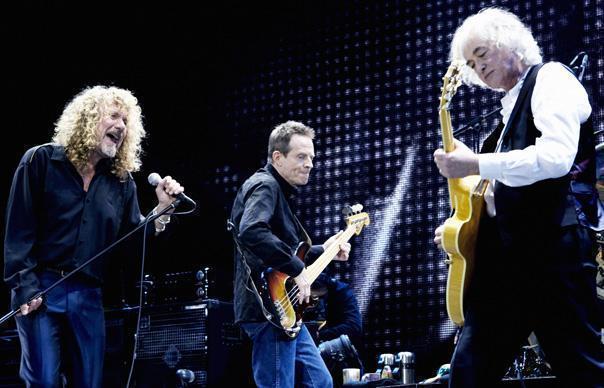
Originally published in Uncut Take 132 (May 2008 issue)…
Originally published in Uncut Take 132 (May 2008 issue)…
Jimmy Page is the last Zeppelin member to be interviewed, on Monday, March 10, at the Gore Hotel, a discreet establishment in Kensington. On the day that the UK is hit by its worst storms in 25 years, a healthy‑looking Page – 64 years old, clad entirely in black, with slicked‑back white hair – meets Uncut in a basement room of the Gore, which is decorated with tapestries, candelabras, ornate mirrors and log fireplaces.
The tapestries have a slight Transylvanian aspect, with spooky castles half‑visible through small gaps in dense forests. The room is painted a deep, rich peppermint green. After friendly introductions, Page, who has recently been filming a documentary with Jack White and The Edge (“three generations of guitar players – yep, you’ve got it”), sits himself down on a low, purple velvet settee. Teetotal for some six years now (although he still enjoys the odd cigarette), Page drinks black coffee and sips water throughout the interview.
Shall we begin at the O2 Arena? “Why not!”
ON MEMORIES OF THE O2 REUNION CONCERT
UNCUT: What memories and emotions from the night of December 10 stand out for you?
JIMMY PAGE: First of all, I think that what we intended to do, we accomplished. Judging by the feedback, it really moved a lot of people. It was a totally different show to the production rehearsal beforehand, but that was intended; we wanted to be able to move this way and that, musically, within the framework of the songs. So, yeah, on reflection, it was mission accomplished.
UNCUT: Was there a point in rehearsal when you thought, “We’re going to be OK, we’re going to pull this off”?
JIMMY PAGE: Yes, at the first rehearsal. Look at the psychology of it. If the four members get together in a room to play, nobody wants to be the one who causes it not to work. Everyone went into that room with a will, I believe, to make it work. And it was really exciting to be playing the music with such intent.
UNCUT: You walked onstage at the O2 wearing shades. What could you see in the faces of the front rows?
JIMMY PAGE: I wasn’t concentrating on the audience. It was heads‑down for the first three numbers, which we did as a medley, non‑stop, and when I took my glasses off, I didn’t see the audience then, either. I was just getting lost in the music. We’d paced ourselves for this concert, we’d given it our total commitment, and nothing was going to get in the way of it – not even broken fingers – forget it, nothing was going to get in the way of this.
UNCUT: What were the most stunning performances that night?
JIMMY PAGE: From the feedback I’ve had, it all built towards “Kashmir”. Everybody who remarked on it, whether it was the public or other musicians, said that “Kashmir” was totally out of this world.
UNCUT: What was it like backstage afterwards? Was it emotional?
JIMMY PAGE: It was. I had my young kids there. I was really keen to see them before the show, and then after it, as I knew it was going to be a very intense spectacle for them. I spent most of the time in a room downstairs with my family, and the families of John Paul Jones, Robert and Jason. It was emotional. It was extremely emotional onstage as well. Intense. But a positive emotion. It was a joyous experience, a celebration.
UNCUT: Almost all the reviews praised your playing, and John Paul Jones has told us there were times when he felt you were playing better than ever…
JIMMY PAGE: That’s really kind of him. I must say there were moments. The thing is, when you’re going for the spontaneity of the night, if you like, you really want to know that you can still do it. I knew I could. People think I haven’t been playing lately, but I have. I’ve been playing all along.
UNCUT: Zeppelin’s music was written while you were in your twenties and thirties. Is there anything intrinsic in those songs that makes them fiendishly difficult to play in your sixties?
JIMMY PAGE: No, I wouldn’t say so, providing you’re mentally and physically sound – the original players, that is; I wouldn’t say that any guys of 60 could play that music. There’s more complicated music than what you seem to be saying. There’s a subtlety in how it all synchronises together.
UNCUT: Sure. I wasn’t suggesting that Uriah Heep, in their sixties, would suddenly be able to play Zep stuff.
“it was extremely emotional on stage. intense. but a positive emotion, a celebration.”
Jimmy Page
JIMMY PAGE: No, and I wouldn’t be able to play Uriah Heep stuff! But with good concern, that music is probably going to go through to the DNA imprint of my children and my grandchildren because it’s so much a part of me. I just go into a sort of… For example, a number that we did in the rehearsals was “The Rover”. Now, we hadn’t played “The Rover” before, not in a complete version.
UNCUT: I always think of “The Rover” as a perfect illustration of Zeppelin at their most confident.
JIMMY PAGE: That sort of swagger? It’s got a real swagger about it. That intentional swagger is there.
UNCUT: Well, I was thinking more about the fact that you write this great song, which most bands would kill for, and then you casually leave it off the album (Houses Of The Holy) that it’s supposed to go on.
JIMMY PAGE: Well, yes, but it had its time and its place. The place for “The Rover” suited clearly where it comes in on Physical Graffiti, and that shows it really works.
UNCUT: Will there be a CD and DVD from the O2?
JIMMY PAGE: It was recorded, but we didn’t go in with the express purpose of making a DVD to come out at Christmas, or whatever. We haven’t seen the images or investigated the multitracks. It’s feasible that it might come out at some distant point, but it’ll be a massive sort of task to embark upon.
UNCUT: We learn in our Sunday newspapers that Robert has turned down an offer to tour the world with Zeppelin. What’s the situation – could a tour happen?
JIMMY PAGE: The focus was the O2 show. That’s what I had my focus on. As for Robert, he had a parallel project with Alison Krauss and it’s been successful, which I suppose means he doesn’t have time for Zeppelin at this point. What I do know – what I do know – is that the rehearsals, and the O2 gig, were really special.
UNCUT: Right, but are Led Zeppelin…
JIMMY PAGE: That’s as fair an answer as I can give you.
UNCUT: Can’t you go any further than that?
JIMMY PAGE: I don’t know what John Paul Jones has said, and I don’t know what Robert has said. But I know how I feel.
UNCUT: But it sounds like you, yourself, are open to the idea of a Zeppelin tour, and possibly an album?
JIMMY PAGE: Don’t put words in your mouth? Well, don’t put words in my mouth. I know how… Look, I started this by saying that there was a will to succeed at work in those original rehearsals. And everybody had such a commitment to it. Now, if you’re talking about a tour – other dates, maybe recording – there’s only one tune that’s going to be the common denominator there. And that’s commitment. That’s how we did the O2.
UNCUT: Somewhere in a Zeppelin office, though, is the phone ringing off the hook? Offers from American promoters, inquiries from record companies…
JIMMY PAGE: Oh, I’m sure there is. I’m sure there is.
UNCUT: Do you get bothered with that on a daily basis?
JIMMY PAGE: In what respect would I get bothered with it? No, I don’t get bothered with it. I do get bothered with it, I suppose, because there are so many people who may recognise me, who come up and say, either (a) they went to the O2 that night or (b) they didn’t and are we touring? And I have to say, “Well, at the moment, we’re not. At the moment, there are no plans.”
UNCUT: At the very least, has this given you a new boost of energy and purpose? For instance, you were interviewed in 2004 and said you were working on “new, radical, unexpected” material. What stage of development has that material reached?
JIMMY PAGE: I’ll tell you exactly the sort of music I’ve been writing. They’re the sort of vehicles and frameworks which could be applied – because I remember saying one thing in that interview, that “a good riff is a good riff” – but these are vehicles that could be used in various situations. I might have one thing that could just as easily be recorded with an ethnic drum orchestra as with a rock ’n’ roll band. Do you see what I mean? Or you could play it acoustic. It’s the application of it. But I’m ready, I’m ready now to present this stuff that I’ve got.
UNCUT: I don’t know if you’ve noticed, but it’s been 10 years since you last released an album of new songs, which was Page & Plant’s Walking Into Clarksdale…
JIMMY PAGE: That doesn’t matter! No! What does that matter?
UNCUT: There was a time when…
JIMMY PAGE: No! I’ve done other things since then… There was a time when what?
UNCUT: When you’d have been desperate to let the public hear the latest music you’d created. To let it be heard, enjoyed and admired.
JIMMY PAGE: What, you mean, within the working vehicle of a band? Oh, yes, yes, that’s right. But I haven’t had a band to tour with. No, but I’ve done a number of projects, though.
UNCUT: But not new albums. Not since 1998. You did a live album with The Black Crowes, but that wasn’t really a new album.
JIMMY PAGE: Yes, but I’ve just done a documentary, and I did some of my new music in that. I’ve got enough new music to make it sort of… sort of tantalising and… yes, to re‑apply a commitment to that, shall we say.
UNCUT: When you look back at the way you put Led Zeppelin together in 1968, does it sometimes seem ridiculously easy? I mean, you ask Terry Reid to be the singer, who says no, but he knows this bloke who’s absolutely perfect, and he just happens to know the best drummer in Britain.
JIMMY PAGE: Have you heard River by Terry Reid? No? Because if you haven’t, I’m just trying to show you the reason why Terry Reid was considered. Also there’s something that’s relative to the whole timing of this. You just said that John Bonham was the greatest drummer in England. I thoroughly agree with you. But his reputation had not reached London. He hadn’t come out of the Midlands yet.
He’d just started to play with Tim Rose – he certainly wasn’t playing with Robert – but when I heard John play, it was, well, there was just no doubt about it. I’ll tell you what, you just felt it. Everyone felt John Bonham.
UNCUT: If Terry Reid had said yes, Zeppelin would have got a great singer – but you wouldn’t have had that ethereal, haunting quality that Plant brings to the first album. It’s quite a disturbing sound in places; he’s almost on the cusp of male/female sexuality. Was anyone else singing like that at the time?
JIMMY PAGE: Not to that degree, no. He stretched his vocal range way beyond what anyone else had done. The likes of Terry Reid and Steve Marriott had the attitude, and the mid‑range, but Robert was doing sort of vocal gymnastics. He wasn’t singing like that when I heard him up in the Midlands. I don’t think he’d ever sung like that before the first Led Zeppelin album. I don’t think John Paul Jones had ever played like that before. Nobody had played like that before. I certainly hadn’t.
“ROBERT WAS SORT OF DOING VOCAL GYMNASTICS. HE STRETCHED HIS VOCAL RANGE WAY BEYOND WHAT ANYONE ELSE HAD DONE.”
Jimmy Page
UNCUT: Is it true “Whole Lotta Love” was written onstage during a gig in America, when you were all jamming on a Garnet Mimms song?
JIMMY PAGE: No. No. Absolutely incorrect. No, it was put together when we were rehearsing some music for the second album. I had a riff, everyone was at my house, and we kicked it in from there. Never was it written during a gig – where did you hear that?
UNCUT: I read it in a book.
JIMMY PAGE: [Sarcastically] Oh good. I hope it was that Rough Guide. That’s the latest one, the most inaccurate. They’re all inaccurate, you know.
UNCUT: You were one of the first producers, around 1968, to realise people weren’t just listening to music on mono record‑players any more, but had moved on to stereo, and headphones.
JIMMY PAGE: Yeah! Well, I’d been touring America with The Yardbirds, and something that was apparent was that there were two streams of radio. One was the Top 40 AM stations, which were playing the singles, and the other was the FM stations which put on whole albums. I thought this was magnificent, because you’d hear what a band was really up to. That registered with me. Those FM listeners were the sort of people I wanted to reach.
UNCUT: But the stereo aspect? There are a lot of very impressive sound effects on early Zeppelin LPs.
JIMMY PAGE: I knew for sure that people were listening on headphones. It was something that was really important within the production. You get lots of movement going on. Apart from the fact that it was fun to do, it presented an incredible picture in your head as you were listening.
UNCUT: How was the swirly effect at the end of “When The Levee Breaks” achieved? I always imagine you sitting there with a joystick…
JIMMY PAGE: It’s sort of like that, isn’t it? It’s interesting on “Levee Breaks”, you’ve got backwards harmonica, backwards echo, phasing, and there’s also flanging, and at the end you get this super‑dense sound in layers, that’s all built around the drum track. And you’ve got Robert, constant in the middle, and everything starts to spiral around him. It’s all done with panning.
UNCUT: Was it important that Zeppelin should become a huge band, an internationally renowned band, as well as a bloody good one?
JIMMY PAGE: Initially, coming from The Yardbirds and putting it all together, I had a long‑term plan that it wasn’t just going to be a band that would make singles and trite music. It was going to have longevity, and it was going to make profound music. That sort of ethic – well, you want to have success, don’t you, as that means your music is going to be heard. And also your contemporaries would say: “That’s a really good band you’ve got there.”
And we didn’t – this is the key – we didn’t have to worry about singles, and “Is there a follow‑up to ‘Whole Lotta Love’ on the third album?” No! We don’t want one! Because that’s going to restrict you. The whole thing was to burst out, burst open, and go over the horizon and beyond, and beyond, and beyond.
UNCUT: “In My Time Of Dying”, on Physical Graffiti, ends with a joke and a burst of laughter. It seems a bit inappropriate, I feel, after such a devastating 11‑minute performance. Was that humorous reaction typical of Zeppelin in the studio?
JIMMY PAGE: We were just having such a wonderful time. Look, we had a framework for “In My Time Of Dying”, OK, but then it just takes off and we’re just doing what Led Zeppelin do. We’re jamming. We’re having a ball. We. Are. Playing.
UNCUT: When you worked on the DVD of The Song Remains The Same, what went through your mind as you watched footage of the young Jimmy Page in ’73?
JIMMY PAGE: Well, it was sticky tape and glue, really. The live footage was shot by the film crew over three nights. They shot more than that, but they might have had problems with their communications because you’d find, when all the film was viewed, that they had whole areas that were missing in the songs.
There were so many holes in it. So I’m sort of miming at Shepperton to what I’d played at Madison Square Garden, but of course, although I’ve got a rough approximation of what I was playing from night to night, it’s not exact. So the film that came out in the ’70s is a bit warts‑and‑all.
UNCUT: You haven’t quite answered my question. When you look at the guitar player in those scenes at Madison Square Garden – he’s the leader of the greatest rock band in the world, he’s dressed in a fabulous outfit, he’s playing guitar with a violin bow, he’s got the best haircut he’s had in his life…
JIMMY PAGE: Hahahahaha!
UNCUT: …do you look at him and think, wow, my God, he’s pretty impressive?
JIMMY PAGE: [Pause] I look at him and think, “He’s really living it. He’s really, you know, in his music.” And that’s wonderful. I can relate to that, and I can see him taking chances, and I can see him making mistakes.
UNCUT: You’re often described as the curator of Led Zeppelin’s heritage. Are you?
JIMMY PAGE: No, I’m not, but I’ve certainly tried to make sure that there wasn’t a rape and pillage of it. I’m very conscious that less is more.
UNCUT: Was playing with Robert at the O2 a very different experience to the Page & Plant tours of the ’90s?
JIMMY PAGE: Of course it was different, because it was better. With no disrespect to the musicians who played in Page & Plant, it’s got to be better to play the music with the key members who’ve written it. So that’s Robert, that’s me and that’s John Paul Jones.
UNCUT: Why did Page & Plant end when it did?
JIMMY PAGE: The LP was all right, but it was scaled right down. There could have been a follow‑up, but it’s a leading question, isn’t it? I had some material written for another album. I had about a dozen numbers, and some of them were really good, but Robert heard them and he wanted to go in another direction. He wanted to do a solo album. Fair enough.
UNCUT: Robert’s now touring with Alison Krauss. Does it infuriate you? Do you feel like saying, “But Robert, this is LED ZEPPELIN we’re talking about!”
JIMMY PAGE: No, because he’s made many departures and that’s what he feels he needs to do. No, he can do what he wants. We’re all grown men, for heaven’s sake. But I know what is inspirational, and what is really challenging, and that is the sort of direction that I personally – personally – intend to go.
UNCUT: If there were to be a new Zep album, would you expect to be the producer as before?
JIMMY PAGE: No, I’m not getting into that.
UNCUT: I know you built those Zeppelin albums to last, but could you really have imagined that people would be listening to them 40 years later?
JIMMY PAGE: I hadn’t really considered that I would be around to witness 40 years later. But I knew that I listened to blues from the ’30s, and rock ’n’ roll from the early ’50s. I was listening to a lot of music that predated my birth. There was a possibility that [Led Zeppelin] would be listened to. I believed that the musicianship on the Led Zeppelin albums is… I don’t want to say it’s a textbook for musicians, but it has a hint of that.
Anyone who plays an instrument, and who appreciates the tactile quality of it, there’s a lot for them. And not only that. People who don’t play music at all – there’s still a lot there. You can hear it. You can appreciate how it was put together.
The post “We’re jamming. We’re having a ball. We are playing” – Jimmy Page on Led Zeppelin’s 2007 reunion appeared first on UNCUT.