Originally published in Uncut Take 275 (April 2020 issue)…
Originally published in Uncut Take 275 (April 2020 issue)…
After Led Zeppelin disbanded in 1980, Robert Plant embarked on a peripatetic solo career that has taken him far beyond the gravitational pull of the mothership. Here, rock’s redoubtable traveller looks back on many marvellous sonic adventures. A string of collaborators, meanwhile, share insights into his working practices. “I come and go in the game I play,” Plant tells Michael Bonner. “I have the audacious expectation to be invisible most of the time. But, really, I just like to sing…”
“Being in a band like Led Zep was magnificent and also quite frustrating,” begins Plant. “Because you were in it and it was a democracy, it worked when it worked, and it didn’t work when it didn’t work. But to suddenly be completely free to fail? That was a totally different mindset altogether. And magnificent because of it.”
It is late 2019 and Plant is at home in the remote, wild English‑Welsh borders contemplating his past. He is not long back from a North American tour with the Sensational Space Shifters, the disparate collection of musicians who have accompanied him on his fantastical musical adventures, on and off, across the past three decades. The tour, Plant reveals, was the last hurrah for his most recent album, 2017’s Carry Fire.
For now, though, future plans are on hold. For an artist as forward‑looking as Plant, today he is making a rare detour in the other direction, to the years after Led Zeppelin ended.
The trigger for Plant’s current bout of reflection is a podcast, Digging Deep, which began in May, in which he discusses one song from his storied career in each episode. The podcast – which finished its second series in December – has subsequently led to a 7″ boxset, also called Digging Deep, which gathers together two tracks each from Plant’s first eight solo albums, beginning with his 1982 solo debut, Pictures At Eleven.
“I don’t really need much of a prompt to get excited about stuff,” explains Plant. “I’ve always spent so much time going forward, going from a present tense to a future tense, I’d completely forgotten about the structure and various other aspects of those early songs. I was encouraged by some friends who said, ‘Why don’t you play some of that shit when you’re actually doing gigs with the Space Shifters?’ I said, ‘I don’t know. Why don’t I?’ I suppose it’s because I’m always concentrating on today and tomorrow. So it seemed like a good adventure.”
“I have the audacious expectation to be invisible most of the time. But, really, I just like to sing…”
Robert Plant
Adventures, of course, are an integral part of Plant’s ongoing mythology: musical or otherwise. Among its many qualities, Digging Deep traces Plant’s evolution as a solo artist. But as much as his career is defined by a thirst for change, it also contains an intriguing tension with Zeppelin as well as his friendship with Jimmy Page. It is a complex business, as Plant himself would agree. At the start of his solo career, profoundly affected by the death of John Bonham and the subsequent break‑up of Zeppelin, Plant actively distanced himself from his old band. There were occasional recouplings with Page – live and on record – interspersed with largely disappointing Zep reunions. Finally, though, Plant reached a point where enough time had elapsed for him to find pleasure in publicly reconnecting again with his legacy.
But which Robert Plant are we talking about here anyway? The erudite scholar of the blues, perhaps? The tireless advocate of ’60s psychedelia? The well‑travelled explorer investigating the congruence between North African rhythms and Celtic folk? Or maybe the technocrat, eager to embrace emerging studio hardware? As the boxset makes clear, each project has demanded new tactics – new collaborators, too – and Plant has adjusted to match the temperature and shape of the music.
“It’s different processes, different personalities playing the music,” says Plant. “Maybe a different motive behind it. Some of it being from a while back, it had a whole different lyrical or vocal personality. I’m not asking anybody to get into the groove of what I do. I just do it. I’m never gonna be everybody’s favourite. I don’t do it in the way that everybody would probably like it.”
THE END OF ZEPPELIN
On paper, Robert Plant’s solo career began on December 4, 1980 – the date Led Zeppelin publicly disbanded. The truth is a little more complicated than that. As befitting a band of such magnitude, Zeppelin exerted a gravitational pull from which it was difficult to escape. The loss of John Bonham on September 25 that year had an incalculable impact. “Bonzo and I had been together since we were 16,” notes Plant. “It was always pretty combative, which was great fun. In the Band Of Joy he’d set up right at the front of the stage so he could get another job, ’cos people could see him. I was standing next to him going, ‘Fuck off out the way, will you? I’m at the front.’”
While Zeppelin had been, musically and financially speaking, the heaviest group of the 1970s, a solo career was a matter of gradual progress, not overnight miracles.
“I’d been hanging around with a lot of people where I live,” Plant explains today. “People had been making records, but I hadn’t imagined myself taking on anything where it’s just got my name on it. I’d been in this magnificent fortress – Fortress Zeppelin! – so there was no real melding with anybody apart from a few frivolous things around my home area with people like Andy Sylvester and Robbie Blunt.”
This was the Honeydrippers, who toured local pubs and small clubs during early 1981 playing R&B covers. To some, the Honeydrippers were an intriguing puzzle. Had Plant given up the jet‑set glamour of Zeppelin for this?
The original Honeydrippers were over by the summer – but a precedent had been set for the kind of mercurial moves Plant continues to make throughout his career. Strategically, too, the Honeydrippers allowed him time away from prying eyes to rally himself and to consider his next steps. He is asked whether he could move much faster as a solo artist, away from the scale of Zep’s infrastructure…
“There was no infrastructure in Zeppelin!” Plant laughs. “Don’t for a minute think it was like a Fleetwood Mac tour. These were days when people didn’t even have a guidebook. With Zep, Bonzo and I, we knocked six bells out of each other, but the next day we got up and played to our strengths,” he continues. “It was not a delicate ‘excuse me’. But when you start working fresh with people, you have to be quite tentative about things.”
For Plant, then, his first steps towards a fully fledged solo career were cautious and exploratory. He set up a makeshift four‑track studio in a barn at Jennings Farm – his home near Kidderminster. At first, work was conducted in the company of Robbie Blunt and Benji Lefevre, Plant’s former vocal assistant in Zeppelin. These were two sympathetic and long‑serving allies; as the sessions progressed, Plant introduced a newcomer to the mix.
“THERE WAS NO INFRASTRUCTURE IN ZEPPELIN. DON’T FOR A MINUTE THINK IT WAS LIKE A FLEETWOOD MAC TOUR.”
Robert Plant
“My two brothers and I had a music shop in Birmingham,” begins Jezz Woodroffe. “I played keyboards with Black Sabbath for two years, then I started working in the shop, in the keyboard and electronic music department. Robert walked in one day and asked if I would help him write the songs for his first solo album. That’s how it started – I was always in with the technology. I spent most of my money, working with Robert, on Fairlights and PPGs and mental expensive stuff like that.”
“Jezz was the guy who hid behind the curtain with Black Sabbath,” says Plant. “He was very, very musical from the exquisite side of chordal progression – his father was a renowned piano player with Jack Hilton. So the idea of him ending up with Black Sabbath is quite funny really, considering he was and still probably is so musical. There was a quest for him there – and there was with us. He had a lot to offer.”
Sessions moved to a more formal setting: Rockfield Studios in Monmouthshire. Gradually, a full band was assembled. Paul Martinez joined on bass and – how else to follow the mighty chops of John Bonham? – the services of two drummers were required: Cozy Powell first and then Phil Collins.
“I was living just outside Guildford and I got this phone call from Robert,” remembers Collins. “I was dumbfounded. I didn’t know him at all. He said would I like to play on his album. So more dumbfoundedness. He sent me a cassette of his new material with Jason Bonham on drums. I went to Rockfield and straight away we hit it off. We worked through the tracks in about a week. We became quite close – Robbie Blunt, Paul Martinez, Jez Woodroffe, me and Robert. It was nice to be part of a group that talked and drank like a group.”
For Plant, the release of Pictures At Eleven in June 1982 was the beginning of a new perspective on life. There was a new band, new songs and even a new look. By the time the cover photo for Pictures At Eleven was shot, Plant had had his hair cut. Such symbolic gestures aside, he confirms his view that Pictures At Eleven was a noble attempt “to break the mould of expectation of me being part of some huge juggernaut”.
Pictures At Eleven is the sound of Plant searching for common ground between his past and the future. “Burning Down One Side” and “Like I’ve Never Been Gone” have an easy‑going assuredness, although perhaps inevitably they are still very much in debt to late‑period Zeppelin. Woodroffe’s keyboard swirls and Blunt’s soloing on “Burning Down One Side” signal back to Presence, while “Like I’ve Never Been Gone” has the tenderness and expansiveness of “Since I’ve Been Loving You”.
“He’s a very lyrical guitarist, a beautiful player,” acknowledges Plant today, singling out for particular praise Blunt’s playing on “Like I’ve Never Been Gone”. “Yet he could play just like that in the pub down the road and you would miss it. If you get into Rockfield with him playing like that – all the beauty of that comes out.”
Moving at speed, work began that summer on a follow‑up – including sessions in Ibiza, to enjoy the sunshine and good vibes – before a longer stint in Rockfield. “Robert’s first two albums were quite traditional, what you’d expect him to do, and the Zep fans just took it,” says Woodroffe. “The second one was more constructed around how the band worked. ‘Big Log’ came from that.”
You can find footage on YouTube of Plant singing “Big Log” on Top Of The Pops from July 28, 1983 – the month before his 39th birthday. “Performing in a 65‑square‑foot corner of a studio while Pan’s People were doing workouts opposite while you were on camera… It was all new territory for me,” admits Plant today. “At the time, it was part of the game and I was up for playing because I’d been away from everybody else’s world for forever.”
If Zep’s vertiginous rise had more to do with radio – and vital early exposure from influential DJs like John Peel and Alexis Korner – in a different era, it was MTV scheduling “Big Log” on heavy rotation that opened the door for Plant’s solo career.
“The tour sold out everywhere, we had a brilliant time,” says Jezz Woodroffe. “But the record company said, ‘It’s great you’re playing 20,000‑seaters – but the way you play 50,000‑seaters is if you play “Whole Lotta Love”.’ We said, ‘We can’t do that – we might as well get Page to come back.’
“That happened one night. We’d sold out Madison Square Garden. Page had been hanging around backstage. He said, ‘Let me get on and do one number.’ Robert said, ‘Yes, come on.’ Page had this scarf on, a gin and tonic in one hand, and his Les Paul – and as soon as the crowd saw him the roof came off the place. It just put our whole show into insignificance. They hadn’t done anything! It was just the reaction of the pair of them being together on stage. I thought, ‘Now what do we do?’”
SHAKEN ’N’ STIRRED AND BEYOND
For Plant, perhaps his growing confidence as a solo artist – two Top 10 albums, a hit single and a sell‑out arena tour under his belt – enabled him to temporarily renew his musical partnership with Jimmy Page. Together with Jeff Beck and Nile Rodgers, Plant and Page recorded an EP of 1950s rock’n’roll songs under the revived Honeydrippers moniker.
The Honeydrippers may have offered fans the Plant–Page reunion many wanted – just not quite on the terms they expected. Similarly, Plant’s next solo album, Shaken ’N’ Stirred – released in May 1985, two months before the Zeppelin reunion at Live Aid – found him taking yet another sharp left turn. After Pictures At Eleven and The Principle Of Moments, did he feel he was becoming… comfortable?
“People say, ‘Why don’t you stay with one thing, then everybody knows what’s on the tin?’” says Plant. “I reply, ‘When we were 16 or 17 and we were listening to Moby Grape and Son House, we hadn’t actually written anything down yet, but we were being inspired by tangential stuff.’ So I’ve always wanted to move around. I experienced so much creative acceleration for a period in the ’70s that I wanted to keep doing different things.”
“‘Big Log’ doubled or tripled the sales of the previous album,” explains Jezz Woodroffe. “Then Robert said, ‘What are we going to do now?’ So the band wrote some more stuff which was like Principle Of Moments Pt 2. I thought it was just regurgitating the same stuff, then Robert listened to it and he said – ‘We can’t do this, we’ve got to do something different.’ So Shaken ’N’ Stirred was Robert’s and my baby. Because I was all, ‘Let’s go modern, let’s get drum machines, let’s get computers.’”
To engineer the sessions for Shaken ’N’ Stirred, Plant hired 22‑year‑old Tim Palmer, whose previous credits included Dead Or Alive, John Foxx and Kajagoogoo. Work began at Marcus Recording Studios in London before moving, after three or four weeks, to Rockfield, where Plant and the band bedded in. Palmer describes the band dynamic in positive terms: “They were all very comfortable with each other.” Lyrics, meanwhile, “were always work in progress. I know that Robert had ideas and he would always sing a guide track, but I think the lyrics were being written as we went along.”
As Palmer recalls, discussions about certain drum sounds offered useful entry points to Plant’s back catalogue. “Robert started making references to Led Zeppelin songs,” he explains. “He said, ‘What Zeppelin albums do you have?’ I said, ‘I haven’t got any.’ The following day he came into the studio and he plopped down a pile of albums and said, ‘Check my old band out, see if you like ’em.’ So that was my introduction to Led Zeppelin!”
If, on one hand, Plant had been content to dip back into the past with the Honeydrippers and Zeppelin’s performance at Live Aid, on the other, his interests in studio technology continued to grow. The polyrhythms and funky, melodic basslines of “Too Loud” recalled Talking Heads or perhaps one of Malcolm McLaren’s magpie‑like creations. “Little By Little”, though a more conventional song, brought into focus Plant’s latest drummer, Richie Hayward of Little Feat, and his gift for mixing groove with unusual patterns. But not everyone was so enamoured with Plant’s new direction. “Robbie [Blunt] was more, ‘What about my blues solo? Where’s my Stratocaster?’” remembers Woodroffe. “Robert made him buy one of these Roland guitar synths, and he hated it. Jimmy Page had one as well and I think Page’s went out of the window because he couldn’t get it to respond the way he wanted it to. It was a machine with strings on.”
“Robert wasn’t driven to have a hit single at that point,” says Palmer. “He was making some music that he felt proud of and he didn’t really care if it sounded like Led Zeppelin or anything else. He just wanted to feel proud of what he did.”
“The album didn’t do very well in the US – it only sold half a million,” says Woodroffe. “It was a culture shock – the old fans didn’t like it, but the new ones did. I met up with Robert at a pub in the Forest of Dean to have a chat about what we were going to do next. We were both given the worst pints of beer we’d ever seen. We looked at each other, looked at the pints, then we left. That was the end of it all, over two off pints of bitter.”
Shaken ’N’ Stirred marked the end of Plant’s creative partnership with Blunt, Martinez and Woodroffe – along with Benji Lefevre, who had helped steer his first three solo albums. A new grouping of supporting players – guitarist Doug Boyle, keyboard player Phil Johnstone, drummer Chris Blackwell, bassist Phil Scragg – helped introduce a different groove with February 1988’s Now And Zen.
“I just wanted to find people who’d got no work and wanted to get fucking moving,” Plant tells Uncut. “But more importantly, it doesn’t matter if it’s me or Billy Cotton’s Band Show, people want to get stuff out, get the savage beast operating properly. You find people – some of them work, some of them don’t.”
Johnstone – and his partner, Dave Barrett – were among Plant’s first recruits. Convening first at Barrett’s home studio in Seven Kings, near Barking, then at The Chocolate Factory in New Cross, they demoed tracks including “Tall Cool One” and “White, Clean And Neat”.
After Barrett’s early departure, Johnstone called in two other friends, Boyle and Blackwell. “We all got together in the rehearsal room underneath London Bridge,” Johnstone continues. “We started writing on the hoof, the way that Robert said that Led Zeppelin used to do. Out of that came ‘Ship Of Fools’, ‘The Way I Feel’ and some others.”
“In the beginning, Doug was almost like a classical guitarist,” acknowledges Plant today. “He was very concerned about where he would draw the line, as far as he wasn’t going to play an equivalent of a Dinosaur Jr solo as he’d spent all his life somewhere on the side of those progressive guitarists like Allan Holdsworth. But his style is brilliant. If you listen to ‘The Way I Feel’ and ‘Ship Of Fools’, his solo constructions are magnificent.”
“We’d rehearse all day,” remembers Johnstone. “Then Robert and I would go to the pub – everybody was welcome, but in the end, it was always just me and Robert – and then we’d talk about the day’s work.”
“Robert and Phil Johnstone were pretty close,” notes Palmer. “Phil brought much more of a pop sensibility to the table, making sure that the chorus was really clearly stated. It was a very different process from Shaken ’N’ Stirred. There was a lot more sequencing and keyboard parts. Sometimes, I’d argue for more guitars behind the vocals. But that’s not really the right approach with Robert. He doesn’t want to be held. He likes to do new things and go in new directions.”
“[ROBERT] DOESN’T WANT TO BE HELD. HE LIKES TO DO NEW THINGS AND GO IN NEW DIRECTIONS.”
Tim Palmer
They convened at Marcus Studios and then at Swanyard, up in Highgate. Guests included Kirsty MacColl and future Curve vocalist Toni Halliday. On one day during recording at Marcus Studios, though, they were joined by a familiar presence: Jimmy Page.
“I always remember in studios you get an assistant, if you’re lucky, who’ll help you out and make the tea,” says Palmer. “The day Jimmy was due, I had two assistants and the techs were in, fixing compressors and checking bits of outboard equipment. Everyone wanted to get a glimpse of Jimmy Page and Robert Plant together.”
“Jim turns up with a four‑pack of Special Brew,” recalls Phil Johnstone. “He drank them remarkably quickly, picked up his Telecaster, plugged in, played one note and I swear it’s the best guitar sound I’ve ever heard in my life. Blew me away. He played the solo in ‘Tall Cool One’ to everybody’s satisfaction. He worked on ‘Heaven Knows’ in his own studio. He delivered back exactly what you hear on the record.”
PERFORMING ZEPPELIN SONGS AGAIN
“The times had changed,” Plant tells Uncut. “We hadn’t got John any more. We hadn’t got anything apart from our ability to do what we do. It was good that he came; I was glad. Also he’d played on the Honeydrippers stuff, along with Jeff Beck and Nile Rodgers. Then you become people who know each other and sometimes you work together and sometimes you don’t. It didn’t carry any of the emotional hangover because Zeppelin faltered and faltered and then failed. So it wasn’t as if it was an overnight shock that it stopped completely. We were already slightly thinking on different lines musically anyway. But we came together and it was a remarkable sound – Jimmy did a great job.”
Johnstone encouraged Plant to add a barrage of Zeppelin samples to the end of “Tall Cool One” – “The Beastie Boys had started sampling Zeppelin,” says Plant, “so I thought, ‘That’s a great idea. Listen to that.’” Palmer remembers loading an AMS sampler with snatches of Zeppelin songs, “playing them in, changing the pitch and just trigging away. It came out sounding really fun.”
Furthermore, the tour in support of Now And Zen found Plant perform Zeppelin songs live for the first time in his solo career. “Robert didn’t want to do any Led Zeppelin songs at all,” says Johnstone. “When we started the tour, we were up in Newcastle. Robert and I were in the hotel bar and I said, ‘Look, you mustn’t regard them as Led Zeppelin songs; they’re your songs.’ We talked about ‘Black Country Woman’ and ‘Down By The Seaside’. Robert played it to me on the guitar. We played ‘Black Country Woman’ the next date in Glasgow. Barrowland has a sprung floor. It was bouncing up and down. The stage was going; it was an absolute riot. When Robert started playing the harmonica, the place exploded. Suddenly we’re over the Led Zeppelin argument. We’re doing songs that Robert wrote. That was that.”
Now And Zen took Plant’s resourcefulness to some unexpected places. A mix of guitar, precision electronics and sharp songcraft, it married the technological sophistication of Shaken ’N’ Stirred with rock heft. Plant wanted to keep moving. Retaining the same band, but with Charlie Jones replacing Phil Scragg on bass, writing began at Plant’s home in Monmouth.
“We’d done a long tour in America, done a lot of writing and then we rushed into the studio to start Manic Nirvana,” remembers Johnstone. “Ahmet Ertegun came over and listened to the guitar solo on ‘Anniversary’ and proclaimed it the greatest he’d ever heard! Coming from Ahmet Ertegun that is something special. But in America there was a bit of confusion. They didn’t know which track they liked. To begin with, about five tracks off Manic Nirvana got on the AOR chart – after that it dropped away and it wasn’t as successful as Now And Zen.”
Johnstone admits now that the attendant tour wasn’t “as happy” as the dates in support of Now And Zen. “The Gulf War had started,” he explains. “When we played San Diego, the naval base was on lockdown so half the audience couldn’t turn up. We cancelled a few shows, the crew started calling it The Manic Vacation Tour. But we did a little tour right at the end called The Tour That Time Forgot, round the backroads of America. Robert and I used to hire a car and drive. Robert had a book called The Blue Lanes that showed you the backroads around South Dakota, places like that. We had a brilliant time.”
After Now And Zen, the songs were getting heavier. March 1990’s Manic Nirvana opted for punchy, hard rock. The dryly titled “Tie Dye On The Highway” arrived with a sample from Woodstock, before the song itself launched into serious riffs and hypnotic runs. Meanwhile, “Hurting Kind (I’ve Got My Eyes On You)” revisited the Valhalla‑by‑way‑of‑West‑Bromwich ululations.
“Every so often in the middle of the album, if he was in the mood, he’d go, ‘Uh‑uh‑uh‑uh… Yeah’ – do an ism,” says Johnstone. “We’d call it a Led Zeppelinism.”
Catching Plant where he’s happiest – in between stations on the dial – there was also a cover of Kenny Dino’s 1960s single “Your Ma Said You Cried In Your Sleep Last Night”, which sampled the bass‑drum sound directly from Plant’s old 7″. “Doing that with the actual sound of the stylus on the original vinyl was idiosyncratic beyond belief,” says Plant. “Nobody gave a flying fuck, but I did. And that’s what counted. Some of the tracks were so ridiculously inventive, but also sometimes a complete and total misfire. I love that.”
“SOME OF THE TRACKS WERE SO RIDICULOUSLY INVENTIVE, BUT ALSO SOMETIMES A COMPLETE AND TOTAL MISFIRE. i LOVE THAT.”
Robert Plant
If Robert Plant were a different kind of artist, we’d maybe be talking about his transition from a hard‑rock behemoth into a quite different beast: more restrained, not so fearless – an august elder statesman, perhaps, or a mainstream showman. As it is, we can say that Plant found ways of pushing forward, creatively speaking. “I always want to come away from a project and think that I couldn’t do it any better because I didn’t do it too long,” he explains.
Certainly, that was what Plant was hoping when he followed Manic Nirvana, three years later, with Fate Of Nations. The size and scope of his musical vision was now accompanied by something else – not blues, not rock. “Robert wanted to go more folk, more jazz,” says Phil Johnstone.
Sessions began in Monnow Valley Studios. They moved to RAK Studios, London, with a new producer, Chris Hughes – the former Adam And The Ants drummer whose credits also included Tears For Fears.
“God bless Robert, he came over to my house,” says Hughes. “He had this idea for the record. The vision was large. He was very concerned that the lyrics meant something, that it was from the heart. I agreed to have a look. The initial period wasn’t super‑easy. Robert had been working with a bunch of guys, but there was a sense that it wasn’t right. They were all great players who had their own opinions and they were pulling him in lots of different directions. He was trying to ringmaster the whole thing. By the time I got embedded in the project, the core was Phil, Charlie and Kevin Scott MacMichael.”
Sessions ran from 10am–10pm. Hughes remembers a collaborative spirit prevailing – “It was all hands to the pump” – though Plant was very much in charge. “The classic thing with Robert is he can walk into the studio like a 7ft Viking full of challenge, or he can walk in like your best mate, full of mischief and humour. So he’d do a bit of both.”
Phil Johnstone and Chris Hughes separately recall the wide‑open studio processes undertaken during the sessions. “Robert is very intuitive; he knows what he’s doing. He brought in new ideas all the time. He never delivered a song and said, ‘That’s it.’ There was always room for change and reflection.”
Guests came and went. Hughes remembers Roy Harper dropping by one afternoon. Moya Brennan, Martin Allcock and Nigel Kennedy all contributed. “Richard Thompson turned up with amp, guitar, hat on, ready to go,” says Hughes. “He told me he was working on a piece. ‘I’ve managed to work out a shuffle, but without the shuff.’ It was a 12‑bar shuffle but he’d removed all the bits that suggested it was a shuffle, yet it still sounded like one.”
Hughes is keen to underscore the variety of songs on the album – themes and ideas that implied a new focus and maturity for Plant’s songwriting. He points to “Network News” as a breakthrough moment – a protest song about the first Iraq war that was followed by similar urgent state‑of‑the‑world missives like “Freedom Fries”, “Takamba” and “Another Tribe” from 2005’s Mighty Rearranger and “New World” and “Carving Up The World Again” on 2017’s Carry Fire.
“It’s just observations from the hill, really,” says Plant. “There’s no way of avoiding the insane realities of the time. You can’t just sing about reckless love.”
“On ‘Network News’, you can hear him singing ‘oil… oil’ very subtly,” says Hughes. “That song was powerful in its disquiet, anger, confusion. But then there’s other tracks like ‘Colours Of A Shade’ or ‘I Believe’ and ‘29 Palms’ that are much lighter, more playful.”
Viewing May 1993’s Fate Of Nations from the present day, Plant agrees the record was something of a turning point.
“I think the development in the songs, the drift of it all,” he says. “Maturity coming round the corner, being able to work with Richard Thompson and Francis Dunnery and Moya Brennan. Nigel Eaton playing hurdy‑gurdy. I was shaping it up for something, the beginnings of Raising Sand or Band Of Joy. The presence of acoustic tracks underneath the actual themes was good.”
“The acoustic guitars and organic feel took Robert back into a more familiar territory,” says Tim Palmer, who engineered Fate Of Nations. “He had gone through all this experimental stuff and then started to see the beauty in some of the things he did when he was younger. Robert had come full circle.”
DREAMLAND, AND THE MODERN ERA
While Fate Of Nations fulfilled its conceptual potential, over the next eight years Plant’s creative energies were directed elsewhere. He reunited with Jimmy Page for 1994’s No Quarter and toured through 1998’s Walking Into Clarksdale, but became tired of arenas and audiences craving Zeppelin 2.0. He then formed the Priory Of Brion with old friend Kevyn Gammond, playing low‑key folk‑rock shows built around ’60s covers by Love, Moby Grape, Tim Buckley, Dylan, Buffalo Springfield, Them and Tim Hardin.
“The Priory Of Brion disbanded with work still to do,” Plant explains. “Yet again, there were gigs to do and they happened to be in Sweden where the whole game had really begun in 1968. So we clawed that together with the aid of Charlie Jones and his contacts with Clive Deamer, Johnny Baggott and Porl Thomson. Meeting Justin Adams was a major turning point. To find a guy who could be so lyrical as a guitar player, and to have such an amazing appreciation of music – to have already been out there in Mali recording the first Tinariwen album. We had work to do so we kicked off straight away by going to covers. We didn’t go to the house in the country to write Sgt Pepper; we just got back on the road quick as a new band. It was all really exciting.”
Dreamland, released in 2002 with his new band Strange Sensation, drew directly on the Priory Of Brion repertoire, re‑imagining those ’60s folk‑psych songs alongside new material. Engineer Phill Brown recalls Plant wanting to “get back to basics”, cutting mostly live at RAK, with Plant singing in the control room and the band stretching pieces like “Hey Joe” until they became hazy, modal trance‑blues. The record’s textures – Justin Adams’ desert‑leaning guitar, John Baggott’s subtle electronics, hand percussion and drones – set the template for Plant’s current era: exploratory, spacious, steeped in roots music but never nostalgic.
By 2005’s Mighty Rearranger, Plant and Strange Sensation had fully hit their stride. Songs like “Tin Pan Valley” found him taking lazy rock aristocrats to task – “My peers may flirt with cabaret, some fake the rebel yell” – while the music fused Saharan grooves, English folk, blues and electronics into something pointedly modern. “We came alive really well in Mighty Rearranger,” Plant says. “That’s where this whole story begins for me. We started building something which was a long way away and I needed my music to be a long way away from everywhere I’d been before. Otherwise you’re just a jobbing musician. You’re gonna do the same thing forever. But I wanted to go to some new places.”
Festival trips to Mali’s Festival in the Desert deepened the connection. Justin Adams remembers pushing a 4×4 thirty miles outside Timbuktu and jamming round desert campfires under the stars; those experiences seeped into pieces like “Takamba” and “The Enchanter”, whose loping rhythms and modal riffs echo the camel‑gait blues of West Africa. From there, Plant moved through further collaborations – Raising Sand with *Alison Krauss, Band Of Joy, and then the *Sensational Space Shifters* albums lullaby and… The Ceaseless Roar and Carry Fire – each folding folk, African music, psychedelia and electronica into an increasingly distinctive palette.
“With the Space Shifters, we know each other well,” he explains. “If we disagree, we disagree. We’ve all gone down the road a few more years, so we have a maturity and probably way more eclectic points of reference than I would have had in the early solo days. It’s a much broader opportunity to go into different idioms.” His writing has shifted too: where young Plant boasted of “lemons” and “inches of love”, later songs like “New World” or “Carving Up The World Again” dwell on politics, migration and ecological anxiety, while others explore grief, ageing and memory with autumnal grace.
Throughout it all, Plant has followed an internal compass rather than audience expectation. Guitarist Justin Adams hears, even in prime Zeppelin, the same wide curiosity that underpins the recent records – a line running from Howlin’ Wolf and Lead Belly through the Incredible String Band, Indian scales and North African trance. That long view underlies the Digging Deep project: first the podcast, then the 7″ singles boxset, revisiting overlooked songs from across his solo catalogue and placing them in new conversations with one another. It is less a victory lap than another experiment, a way of re‑hearing old work through the ears of the restless musician he remains.
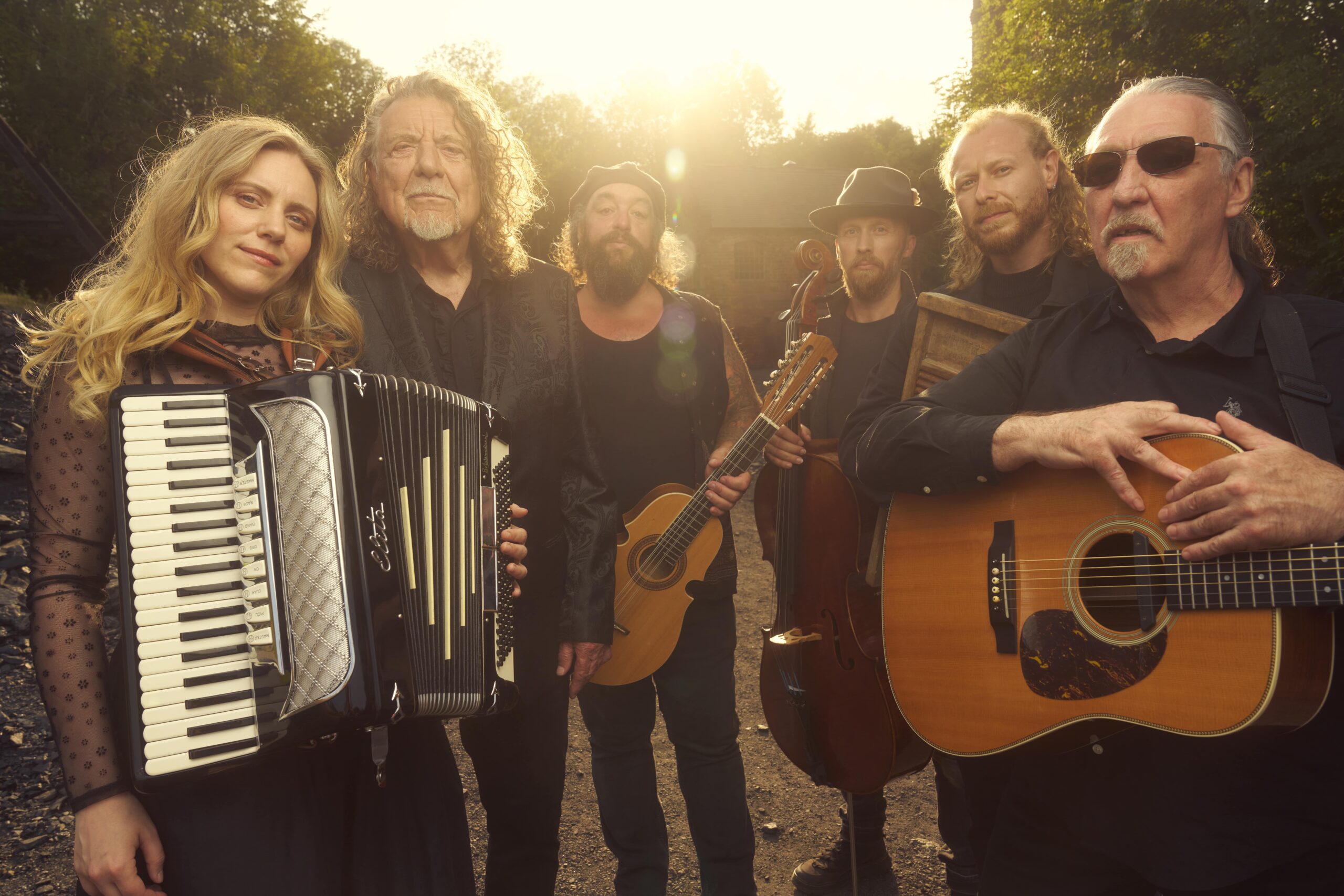
As for the immediate future, Plant is keeping things characteristically loose. He has been touring with Saving Grace, a modest, locally sourced band playing re‑imagined folk, gospel and roots covers in small venues – a move that mirrors earlier palette‑cleansing projects like the Honeydrippers and Priory Of Brion. Records may or may not follow. “I’ve no idea, mate!” he laughs. “I’ve had great conversations recently with the Space Shifters, with Alison Krauss and with Buddy Miller. There’s loads of songs locked up inside us all. I come and go in the game I play. I have the audacious expectation to be invisible most of the time. But, really, I just like to sing…
The post ‘I was suddenly completely free to fail’ – what Robert Plant did after Led Zeppelin appeared first on UNCUT.