Older, Sadder, Better: American Football Leans In On ‘LP4’
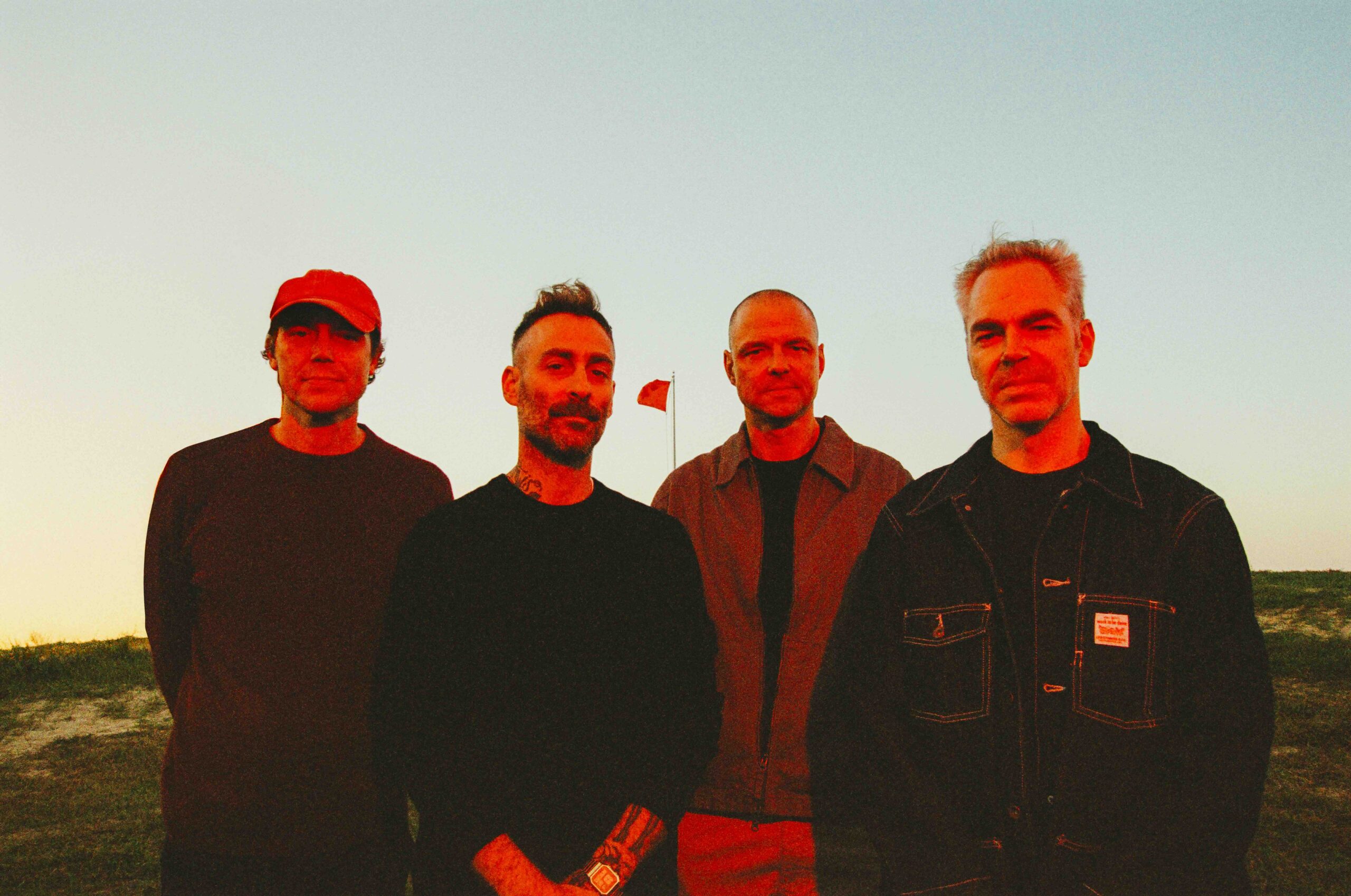
(photo: Alexa Viscius)
On its improbable third album since reuniting in 2014 after a 14-year hiatus, American Football isn’t interested in reclaiming youth so much as interrogating what came after it. The Sonny DiPerri-co-produced LP4 (Polyvinyl) doesn’t just revisit the band’s long-established emotional palette – it complicates it, stretching those heart-piercing guitar lattices and murmured confessions into heavier, stranger and, at times, genuinely disorienting realms. After all, emo boys don’t merely cry – they write songs that make everyone else cry too. Here, that impulse often feels like equal parts catharsis and confrontation.
Opener “Man Overboard” quickly signals the shift. Its knotty, almost dizzying drum pattern and swelling walls of sound feel alien in this context, culminating in Mike Kinsella’s blunt admission, “It’s hopeless.” By the time “No Feeling” settles into something closer to the band’s classic shimmer (heartbeat bass, interlocking six-strings, guest harmony vocals from Turnstile’s Brendan Yates), he’s emotionally checked out, tracing the numb aftermath of endings that don’t come with villains.
If earlier American Football records hinted at adult disillusionment, LP4 plunges cannon ball-style into it. “Patron Saint of Pale” pairs a deceptively buoyant rhythm with the logistical absurdity of divorce (Kinsella suggests a game of Rock Paper Scissors as a novel, lawyer-free way to settle things), while “Wake Her Up” cloaks morbid fixation in one of the most immediate and effervescent melodies the band has ever written. Even the wryness cuts deeper now; “Blood on My Blood” turns self-awareness into a kind of defense mechanism, its zig-zagging groove masking the threat embedded in its lyrics (“don’t make me use my pen” / “my worlds killed before and they’ll kill again”).
The centerpiece, though, is “Bad Moons,” an eight-minute slow burn that spirals from surreal humor into far more unsettling territory. Kinsella’s extended litany of sins committed in the dark — “lost my mind,” “explored new kinks,” “told all my lies,” “slit my wrists” – lands with a cumulative weight that’s hard to shake, especially as the music fractures and reforms around him.
Even the instrumentals feel purposeful. “The One With the Piano” and “Lullabye” offer brief, uneasy respites, while the Music for 18 Musicians-tinged “Desdemona” threads hypnotic textures through a song about intimacy and damage with no tidy takeaways. By closer “No Soul To Save,” Kinsella sounds defiant, exhausted and uncertain all at once. Indeed, from beginning to end, LP4 is remarkably expansive. Not louder, necessarily – just deeper, messier and quite willing to tolerate discomfort. Middle age has never felt, or sounded, like a more beautiful bummer.
To see our running list of the top 100 greatest rock stars of all time, click here.