Originally published in Uncut Take 132 (May 2008 issue)…
Originally published in Uncut Take 132 (May 2008 issue)…
Robert Plant is interviewed by Uncut at 10.30 at his management company, Trinifold, in Camden. It’s cold and blustery and Plant has just driven down from Worcestershire for a day of business in London, which has meant an early start and a long journey. Not that either has had anything remotely like a diminishing effect on Plant’s evidently bountiful energy. He’s 60 this year, but there’s little sense of someone thinking of slowing down, taking it easy. The day after we meet, he’s off to the States, where in April he starts a major tour with Alison Krauss and T Bone Burnett, with whom last year he made Raising Sand, the best album of his solo career.
For the next hour and a half, however, sitting on the edge of a huge leather sofa, he talks at candid length and with enormous affection about his 40‑year relationship with Jimmy Page – “my brother” – the triumphs and troubles they have enjoyed and endured, his excitement at playing with an “on fire” Jimmy at the O2 reunion on December 10, and what comes next for Zep.
UNCUT: So what did it feel like stepping out on the O2 stage with Jimmy after all that time?
ROBERT PLANT: The kind of resonance in there — for people who didn’t have to blink an eyelid to get in there, for people who come from Australia or Japan, to Jason [Bonham]’s family, John’s family, all the families – anticipation and expectation was huge. The potential for failure was also great because nobody knew what it was going to be like.
UNCUT: Did the success of the show test your previously stated resolve not to reform for a full‑blown reunion and tour?
PLANT: Not at all. I really enjoyed it. And hopefully, one day, we could do it again for another really, really good reason. Our profit is – it’s metaphysical. And that’s the thing, especially with my connection with Jimmy. I mean, the two of us are almost umbilically attached in some strange way and have been down the years. And that’s survived everything. From the time I was 19 to now, when I’m 59.
WHEN ROBERT MET JIMMY
UNCUT: You first met Jimmy when he came to see [Plant’s pre‑Zep band] Hobbstweedle play. Can you remember your initial impression of him?
PLANT: I remember it very clearly. He was very reserved, very polite, slightly withdrawn and definitely it was evident to me that he didn’t have the common touch and probably didn’t need it. Even though I was hot and pretty self‑confident, Jimmy, with all his sort of quietude, he had a great advantage. I felt immediately this was a different kind of guy to anybody I’d met before.
So I was welcomed into Jimmy’s home and immediately realised that his interests and the whole landscape of his music and his life was very broad and pretty esoteric. And I just couldn’t believe it. I just thought, “God” – quietly to myself – “this is going to be a real learning curve.” And of course it was, right up until the drugs, right up until it got kind of unworkable in Zep.
UNCUT: Are you saying to some extent that looking at him was like looking into a mirror, that what you saw in him was a reflection of yourself?
PLANT: Only on a superficial level. I was brash and bullish, and he was very retiring. And as much as I was tactile, he was quite the opposite.
UNCUT: As you became more confident with your own role in the band, and started to get a lot more personal attention, was Jimmy cool with that? Or was it a source of friction, given that it was Jimmy’s band?
PLANT: No, not at all. No. I mean, surely, bearing in mind that he’s a very bright man and there’s always reserve behind the reserve, and he’s always got two or three things going on, plus his charm, and he’s got buckets of that now, why would he have a problem with that? He was masterminding the whole thing, so he had to encourage it. And it was there to behold.
I mean, I was doing what I was doing and he was doing what he was doing and it was the two guys at the front. If I’d have been static or if I hadn’t had the appeal or the front myself, I’d have been out of there. Gone.
And during Led Zep I , as far as I was concerned, I thought that I was going to go anyway. I didn’t feel that comfortable, because there were a lot of demands on me vocally – which there were all the way through the Zeppelin thing. And I was quite nervous and I didn’t really get into enjoying it until II, because I thought, “Shit! The equipment was so inferior in those days for vocals, I could never hear myself. There were no monitors, nothing. Nothing.”
So I was quite demure, but at the same time when it came to playing live, that was when I was OK. I could perform because I believed in it. I can’t do anything I don’t believe in. Now, especially.
UNCUT: You’ve described a flourishing personal and creative relationship with Jimmy. When did it start to unravel?
PLANT: Well, we went to Bron‑Yr‑Aur [in 1970, to regroup after a gruelling US tour] to write, to begin work on III and we were brothers then. I had been created in a flurry, on the road in various studios. But here we were on the side of a mountain near Machynlleth, going, “Er, OK.”
But the great thing was that we wanted to change it, we wanted to make it more pastoral. I think Robin Williamson and some of the Incredible String Band were in Machynlleth with some Bulgarian singers in some farmhouse somewhere, so there was a vibe around. It was like, I don’t know, just a feeling, you know, “We’ve got to be able to do something here.”
So we wandered off to a – guess what? – waterfall and played and sang and took the cassette machine, and it was to me bliss, pastoral bliss. Because I really wanted to bring music out of the ground, if you like, rather than out of the city, rather than out of some “squeeze my lemon” place.
We wrote “That’s The Way” one morning, and the lyrics were good – I was, I don’t know, 23. And the magisterial movement of the chords in the stanzas between the verses, it was all one could ever wish for. And as a couple of guys, we really, we sat by the fire at night and I’ve still cassettes somewhere of the old grandfather clock ticking. There was no electricity, outside toilets, the smell of woodsmoke and alcohol. I don’t think we even smoked dope then. I know Jimmy didn’t. He didn’t drink or smoke, really.
And we were really on a roll. We were spectacularly close and we knew we’d got something going which was genuine, not some fabricated bullshit, and being together was something very special. We were really, really good buddies. Later, when Jimmy’s health wasn’t too good [Plant is presumably referring to Page’s heroin use] it wasn’t the same, it was a different time.
UNCUT: As Jimmy became more insular and withdrawn, how much did you miss those adventures you used to share?
THE INTIMACY CHANGED AS TIME WENT ON. SO WE BECAME PART-TIME ADVENTURERS AND PART-TIME DADS. AND THAT’S JUST A SHAME.”
Robert Plant
PLANT: Inevitably, perhaps, the intimacy changed as time went on. Now, health problems are one thing – but also a genuine reason for it to change was the fact we had families. So we became part‑time adventurers and part‑time dads. And that’s just a shame. Because you can never really give enough to either side of it, the wanderlust or the commitment to family.
So the intensity changed. And that period of adventure moved into Physical Graffiti , which was spectacular, which was recorded similarly to Houses Of The Holy, to the extent that we rented a place with a mobile studio, and everybody was pretty cool and it was all great, great, great.
And if there were some dalliances in one direction or another, it certainly wasn’t a solo project. We were all up to no good, one way or another. It’s just a question of how much you’re doing and how the constitution will take it. So I wasn’t upset with Jimmy, I didn’t become remote. He didn’t become remote. We’d both just moved to another place.
And if you think about the difference between III and Physical Graffiti, they’re both great, but Physical Graffiti really is the band at its most creative and expressive. So I don’t think there was ever really a problem right up until perhaps just before I lost my boy [Plant’s son, Karac, died in 1977] and then the actual thing of being on the road touring together was quite questionable for me.
Well… I just thought… I think it was so big that there was no infrastructure to contain it.
By 1977, I was 29, just prior to Karac’s passing, and that sort of wild energy that was there in the beginning had come to the point where we were showboating a bit. Unfortunately, we had no choice. We were on tours where places were going ape‑shit. There was no way of containing the energy in those buildings. It was just insane. And we became more and more the victims of our own success.
And the whole deal about the goldfish bowl and living in it, that kicked in. And that’s what happens. Look at any big group, and that’s generally what happens. There’s no way around it.
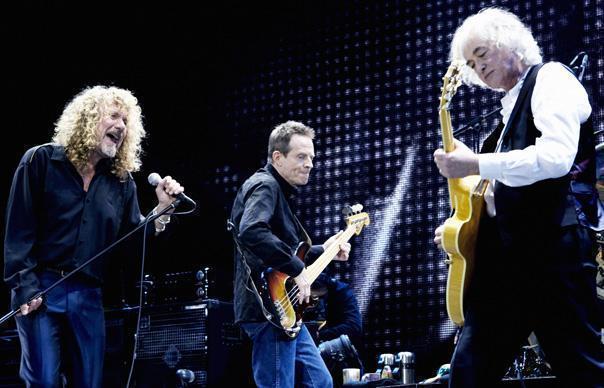
No matter how much you all love each other and no matter how instrumental Peter Grant was and no matter how many security guys we had and all this stuff, it was still insane, because there was no way out. It was like being a crazy Elvis. And so everybody retired to their own corners within the environment, in the hotels. Everybody had their own way of dealing with it.
So the group moved and the individual personalities in the group evolved again. We changed, all of us. But all the time, Jimmy was pushing it, which was great. He was always thinking about stuff. I mean, by the time we were doing Presence – which is before ’77 – I was in a wheelchair. I was pretty banged up.
You haven’t got enough time and neither have I to go through all these changes, but they were all quite amazing, because generally something pretty constructive came out of them, even when things were very painful. And that’s a great thing, I think. We were men. We weren’t tease‑y‑weasy kids. We had to be men because of the things that we had to share – even if we did go home to our own individual soliloquies.
But it kind of went off the rails in the end because everybody got a little bit too relaxed and a little bit haywire. For me, then, it didn’t really work from ’77 onwards.
However, there were moments at Knebworth that were spectacular. But the price you have to pay to get to those moments, I didn’t think was worth it any more. It wasn’t my idea of constructive open‑heart surgery.
PLANT ON PAGE, AND HEROIN
UNCUT: Did you ever confront Jimmy about his heroin use and the effect it was having on himself and the band?
PLANT: I think that with most users, the denial is part of the condition and because most everybody around was in one way or another denying something, there was no central point of solidarity. If Peter hadn’t been so unavailable himself, he might have pulled the whole thing together, because his influence was huge. But it didn’t work like that.
But nonetheless, I still think that by that time Jimmy and I had become quite adept politically at keeping it going, even though I felt very compromised. I also felt for him, you know.
UNCUT: How could you not?
PLANT: Exactly, exactly, yeah, yeah. I mean, he was my buddy. He will always be my buddy. But, you know, everything happened that happened and Jimmy’s come through it and he’s got himself back. He’s now the same guy, almost, whatever the scars and the surgery. He’s got it, he’s back.
UNCUT: How different was he at the O2 reunion from the guy you worked with on the Unledded tour in 1994?
PLANT: If Jimmy was as healthy then – and when we came to do Walking Into Clarksdale – if he’d been as open and as healthy and he’d had the resolve then that he has now, we’d probably have gone somewhere else again. Because I’m always exhilarated by hearing him play.
I think he’s met his demons now and he’s made that public now as much as he can. Without giving too much away, the olive branch came out. And when he brought that branch out – he said, “I offer you an olive branch.”
UNCUT: Has it been painful to watch what he’s been through?
PLANT: Not really, no. You’ve got to make your own way. I mean he’s got great kids, I’m his friend, he’s got a lot of friends. He’s just got to be honest with himself. And I think that’s where he’s at now.
UNCUT: To what do you attribute this new resolve?
PLANT: He’s had a lot of wake‑up calls. I suppose in a way he must be intrigued that some people have stuck around when, like in my case, I don’t need anything from him at all. I just don’t. After all that, after you survey your own projection on other people and some people will just walk. Others won’t. Because there’s unfinished business, definitely.
UNCUT: Do you think it’ll ever be finished?
PLANT: No. I don’t think so. And I don’t think there’s any need for it to be finished. Because as long as he’s got a bit of creative electricity going through his nut, then there’s going to be something to do sometime. It’s just in what form and how much of a compromise it would be to the real root of what we had as Zeppelin.
AS LONG AS HE’S GOT A BIT OF CREATIVE ELECTRICITY GOING THROUGH HIS NUT, THERE’S GOING TO BE SOMETHING TO DO.”
Robert Plant on Jimmy Page
Because all that razzamatazz, people are addicted to it. Everybody wants to have some fun, but we would probably try to go to a different place to have that fun, musically. With a different sort of canvas. But it’s easy for me to say now, with Raising Sand reinventing itself every two weeks. I mean, it’s got its own life. I’ve never been involved with anything with its own life like this. Especially since I wasn’t expecting anything more than a position on the Americana charts in Billboard or something. But he’s been incredibly gracious about that.
Because it was quite an unusual thing. I mean, we’d been planning the release of Raising Sand for about a year, because Alison had to finish her projects last summer, so the release was set for around Thanksgiving. And then, when we agreed that we [Zeppelin] play together, there was definitely a feeling of “What’s going on here? How come he’s doing that, when we’re rehearsing for Led Zep?” Well, I couldn’t help that.
UNCUT: Did that cause any friction?
PLANT: Not really. But it was a kind of incredulous moment when they realised I was bluegrassing it…
UNCUT: Finally, how did you feel as you finished that set at the O2?
PLANT: First of all, we did what we set out to do and more, in every respect. We showed people that Led Zeppelin did go on a bit. There was an opportunity to get a drink occasionally during the show. But at the same time, that’s what we were.
The personality of the audience has changed from those days when everybody was in the same condition as the band. Now it was more like the 68th wonder of the world, rather than a gig. So I felt a bit embarrassed. I felt a bit like I’d gone into character, in a way, even though I sang my nuts off. And the interplay between us all was excellent.
I just wanted to take it somewhere else for a minute. I kept saying during rehearsals, “Maybe we can just drop that bit there and perhaps finish off with ‘Goodnight’ by the Incredible String Band.”
UNCUT: What, from “A Very Cellular Song”?
PLANT: Yeah, that’s it. [Sings] “I was walking in Jerusalem, just like John… Lay down, my sweet Jesus, won’t you lay and take your rest.” And, “Yeah,” Jimmy said. “We always said we’d do that.” And of course we didn’t, because the occasion was bigger than that. And that’s the trouble with the whole thing, about Led Zeppelin. It was always bigger than the beauty of what we had in mind. So I felt like it was a job done, that we were friends, strong, good.
The post “It was like being a crazy Elvis” – Robert Plant on peak Led Zeppelin appeared first on UNCUT.