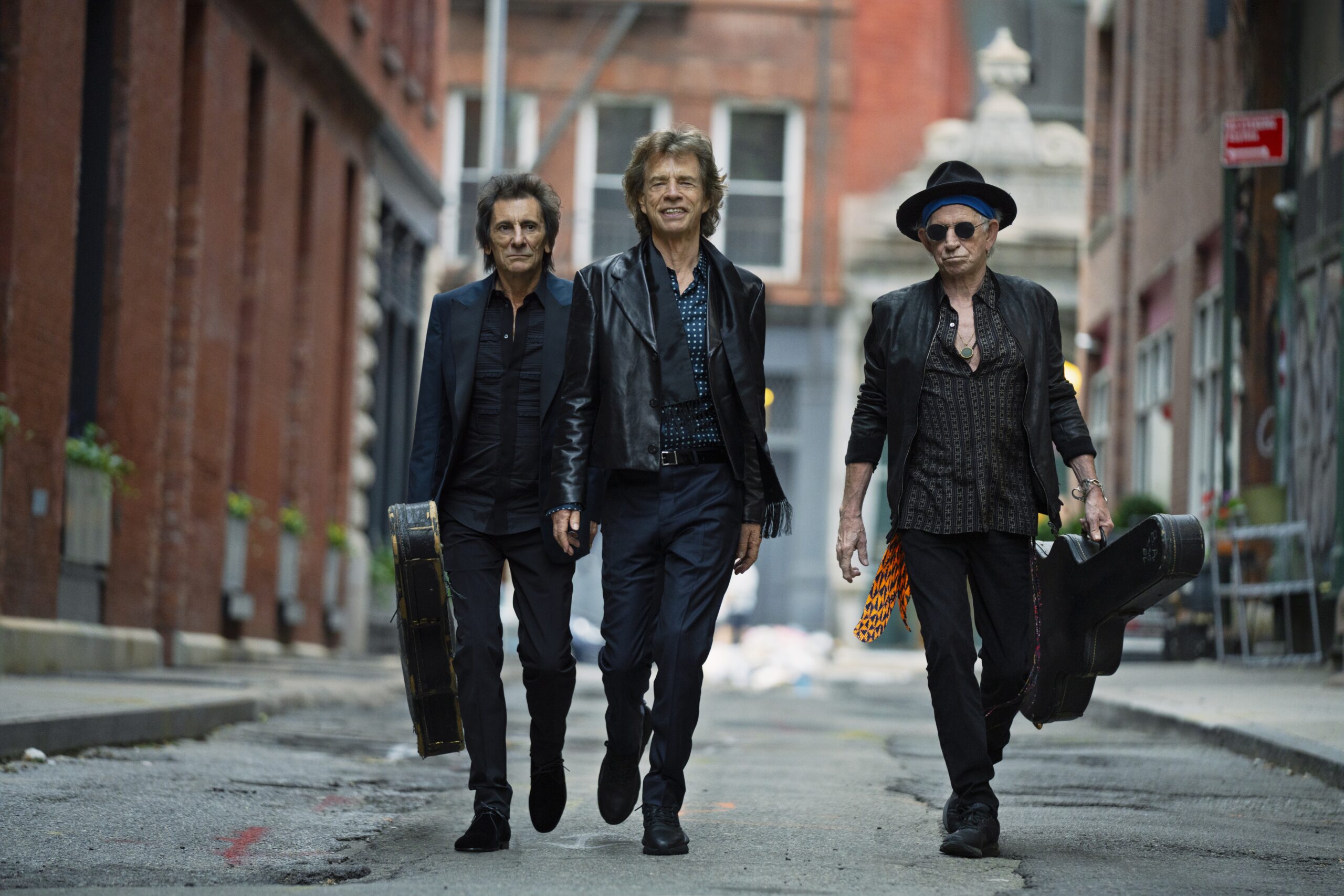
Back in 2002, we assembled an all-star cast of Stones disciples to celebrate and count down the band’s 40 best songs. But when Keith Richards heard about the plan, he decided he wanted in – and personally phoned Uncut from his home in Connecticut to proffer his own unique, insider perspective on the Top 10.
Back in 2002, we assembled an all-star cast of Stones disciples to celebrate and count down the band’s 40 best songs. But when Keith Richards heard about the plan, he decided he wanted in – and personally phoned Uncut from his home in Connecticut to proffer his own unique, insider perspective on the Top 10.
So without further adieu, here’s a little treat for you from the archives: 4,000 words of unadulterated Keef on the Stones.
10. WE LOVE YOU
“That’s jail to me. We were on bail. We thought we were going to go to jail, basically. It was kind of like a last fling before the jail doors started slamming. We thought, ‘Well, you know, we won’t be doing this for a while.’ That was a really low point because we figured they’d really nailed us. And that was kinda going to be our last tune for a while.
“How long did it take to record? I don’t remember really hankering over it. It was such a very slow song so we had to double it up with the timing and everything. I think it was a rhythm thing. Nicky Hopkins was there doing that beautiful piano thing. In the beginning, it was a real dirge. We had to sort of speed it up somehow without losing that dirge-like, prism-like feel. At that time, it was like, ‘Let’s get as much in the can as possible before the door clangs.’ You know, ‘We Love You, Goodbye’ was the original title I think [laughs].”
9. PLAY WITH FIRE
“That’s amazing that people like that because it was such an early one and it was such a delicate little thing. It’s almost like an Elizabethan blues, it has a strange medieval touch about it as well as being very sort of ‘St James Infirmary’. The main thing I remember about it was that it wasn’t necessarily going to be a track. There was Phil Spector taking a day off from The Crystals and The Ronettes and he was on a tuned-down guitar. And Jack Nitzsche, who was the arranger for the Phil Spector stuff, they sort of came to sort of slum it with the Londoners! I think we were kind of like light relief for them, because they were into huge orchestras and all of that. I think we were interesting light relief.
“That was at a time where writing songs… you really didn’t know what you were doing. Not that I do any more now when it comes down to it. I never thought of myself as a songwriter for a long time in that respect and then I realised that, in a way, that was the most interesting thing about what I was doing. I mean, I just wanted to be a guitar player. And then once writing became more serious… it took me so long to actually consider myself as a songwriter. To me, it was all a matter of stitching bits and pieces together and wondering who I’d stolen it from and then eventually I realised that I was influenced but I wasn’t actually a thief.
“What inspired the song? It was a feeling in London. Maybe it was just at that time in our lives. We were playing around, we were considering ourselves a blues band but at the same time we thrust into the world of pop music. In a way, songs like ‘Play With Fire’ were experiments. You’re kind of poking your way, finding out how to write songs and what it was all about.
“And obviously you’re listening to everybody else around you. Dylan was just starting to come around. And there was John and Paul working. There was a whole sort of elevation of the art of songwriting – or at least the status of the songwriter – and being able to write and perform your own stuff so that you were a self-contained unit became quite important.”
8. JUMPIN’ JACK FLASH
“Oh, another one of my little diamonds! It’s a strange thing, because it was all cut on one of those little cassette players and then re-amplified in the studio and then played over again. Its strange, all of that murk in the track. It’s basically because it was recorded in the crudest way possible. I got my acoustic guitar and just totally overloaded it against one of those little microphones that you used to get on those early cassette players. You totally overload it until it sounds more electric than an electric and force it back out through a small extension speaker with a microphone in front of it and then put that on tape and start to play over it.
“I was getting the sound in my own bedroom, you know, with this little machine. And when I took it to the studio they couldn’t get it. So eventually I said, ‘Let’s just do what I do [laughs] in the bedroom and see what happens then.’ You know, a bit of experimentation. It was nuts. We were in Olympic Studios, the size of a cinema, all crouched around a little cassette player on the floor.
“For me, to play ‘Jumpin’ Jack Flash’ onstage, it’s like, ‘Let me at ’em.’ It’s like, ‘Let the tiger out!’ And you still find, like, new ways of moving the riff around and it’s just got one of those great immediate bangs on it. You can’t go wrong once you’ve kicked it off. Then you just sort of hold onto its tail and he kind of takes you.
“I don’t know that I was aware of creating a ‘trademark’ sound on that track. In a way, the style kind of imposes itself upon you. I don’t quite know how it all works. You come up with an idea, or a sound, or a riff, that seems to work, and in a way it sort of takes you over. And you kind of explore it, even though you say, ‘Hey, we’ve been down this road.’ And then something inside you says, ‘Yeah, but there’s more in there.’ So in a way it’s kind of a strange thing, you get to be known for something… and in a way it imposes itself back on you just because of that fact, and then you think, ‘Oh come on, I’m just rewriting “Jumpin’ Jack Flash” again,’ and then you think you’re just honing it down.
“But that song has got a lovely spirit on it and it’s a joy to play… for all of its limitations… in the musical sense, the wonderful rhythmic possibilities still keep you interested. The thing is, with a good song I find, you ask, ‘Hey, do you look forward to playing it the 500th time?’ [laughs] And if you do, then it’s a good song.
7. 19th NERVOUS BREAKDOWN
“’19th Nervous Breakdown’, yeah, it was a great song. In a way, it was harking back to The Everly Brothers, especially on the bridge. Mick and I had always admired the Evs very much. And we thought the Evs would have liked that bridge.
“On our very first tour, a theatre tour that we did, it was probably the equivalent of going to university really, playing with Bo Diddley, Little Richard and The Everly Brothers for six weeks. We probably learnt more in those six weeks about how and what to do onstage, and just little tricks and things. We used to climb up in the rafters after we’d done our bit and watch Little Richard and Bo with the Duchess and Jerome Green and the Evs because that was our first real contact with American black musicians on a day-to-day basis. We thought, ‘Oh yeah, we fit.’ And on top of that, unfailingly enthusiastic people like Bo, Little Richard, they were the ones that gave us the boost. To us, these guys were total superstars. I mean, we were just newcomers. And they gave us such a boost, you know. ‘Hey, play with me.’ Such encouragement. That’s when I started to take it seriously.
“I don’t know if Little Richard was more important to me than Chuck Berry. Chuck has always been my man. Except that now I know the man and I wish I didn’t. In a way, this is one of the few disappointments in my life. I gotta say, Chuck, you asshole. The difference from the work to the person is more than… I mean, I knew Howlin’ Wolf, Muddy Waters, Little Walter, John Lee Hooker, nearly every other great blues player. They were always above and beyond what you’d expect. But Chuck as a person, he’s a disappointment to me. Which is a shame, I must say, still is to me. Those records that he made are still, to me, the greatest inspiration of all time. I think something happened to him when he went to jail. And he never got over it.
“As you go down the pike, you realise really that in musical terms, and as far as musicians and music goes, there’s a weird continuity. You realise that, hey, you know, at the end of the day, a musician’s gravestone, the best thing it can read is that: ‘Hey, he passed it on.’ And, you know, when other guys younger than me come up to me, you realise that you’re just part of a long procession of troubadours and minstrels and balladeers and storytellers and it goes back forever. In a way, you get the strange feeling that you’re part of this weird fraternity. But, you know, nobody carries a card. There are no secret handshakes. But, you get this wonderful feeling of continuity, going all the way back through the mists of time. And you’re just one of those guys that told a story and kept them happy and sang on a song and they took care of you too for the pleasure of the business.”
6. PAINT IT BLACK
“‘Paint It Black’ was this sort of gypsy song that I had going and nobody quite knew how to handle it until Bill Wyman got on the organ with the bass pedals and came up with this sort of Hungarian, Bulgarian, Romanian thing… and I said, ‘Oh, it is a sort of gypsy thing.’ And we were almost putting it on for the first few plays and then we said, ‘Listen, this is like, heavier than that.’ But, in a way, it fell together in the studio. The song was there. But, I mean, I think it was a ballad to start with.
“Brian’s on the sitar, I’m on the guitar. And that was the other thing: adding that Eastern thing. Brian, he was a great fly-by-night. He could pick up any instrument and within 10 or 15 minutes be able to, like, pick up the rudiments of something and add an interesting sound to that. It was like ‘Under My Thumb’ with the marimbas. Brian was one of those guys who’d say, ‘Oh look, there’s a bunch of bells hanging there’ and start clanging away. And we’d say, ‘Okay, you’re on bells!’ [laughs]. So we had a sitar there. I think he’d just bought it or it just happened to be around and he got hold of it and that added that extra, slightly Middle Eastern scale in.”
5. TUMBLING DICE
“We’d just been kicked out of Blighty. You know, it was, ‘Er, sorry, we don’t need you. Get the fuck out!’ In actual fact they were just trying to break us. But we were like, ‘We’ll just move abroad. I mean, it’s not that easy, pal!’ So we were kind of in exile. Even though that was the period when more and more technical things were coming, we cut Exile On Main Street in the most curious way, in a basement with our mobile truck. In a way, we were just improvising and adapting and trying to learn to live outside of England.
“Exile On Main Street was a whole lesson in logistics and finding out if we could actually operate without being able to go home. And can we take this thing on the road permanently? What happens in the day to day? It was such a challenge for us at the time because we realised that we’d somehow turned into a bête noire for the British ‘establishment’. And they really pulled all of their big guns on us. But you can’t keep a good man down. So we thought, ‘We’ll just take it out of the country and see if we can make it float somewhere else.’ In a way, Exile On Main Street was a great vindication for us and also, it being a double body of work, it was kind of like, ‘Up yours!’ [laughs]. I’ve had a taste of Wormwood Scrubs – forget about it! You know?
“I really felt that the establishment was out to split up the Stones. They realised that they’d buttered up The Beatles too much and that they couldn’t hit them because they’d given them medals. Right? Even though they gave them back, well some of them. So we were obviously the ones they hit on. We were the flavour of the year for several years eventually. Not that we didn’t ask for it in some ways. It was like, ‘Come on – give us your best shot, pal.’ And, in actual fact, they gave us their worst shot. Which was quite satisfactory at the time. But I never saw the point of looking a gift horse in the mouth.
“And a tremendous album came out of all that. We certainly rocked it. I remember writing ‘Tumbling Dice’, yeah. I was just there in the south of France, exiled, overlooking Cap-Ferrat and saying, ‘Well, this is actually not so bad’ [laughs]. Because I’d never thought about it before. You know, it was just like work and making lots of money and stuff. But it’s not really… that wasn’t the point. It was, can we keep this going in the teeth of, like, sort of the toughest resistance you can come up against – the implacable Empire? And so, in a way, without anybody really talking about it nobody saw it in those terms – I think there was a real determination to prove the Stones could work no matter where.
“I think maybe, in a way, being outside of England for the first time and saying basically ‘Okay, you’re exiled’, it added an extra bit of grit and made the band think more about the world than just where they came from. Although we’d been touring for quite a while around about then, we suddenly started to feel more global. When you think about it, we’d been touring America by then since 1964, almost every year, so we’re talking 1971, so six or seven years. But by being in Europe and having had time to think about it, all of us had been picked up by working in the south of America and the people we’d met and musicians. After all, Gram Parsons was down there with us and there were loads of other musicians popping in and out. And we started to reflect upon what we’d seen and heard. You know, a lot of times, you’re zooming through places and it takes a while for the impact to sort of settle in on you, you can’t quite tell how it’s going to come out on you. But, probably, a lot of what we’d done in the previous few years, working through America, came out on that album.
“Me and Gram Parsons, we bumped into each other quite a few years before then. Hey, if we hadn’t been musicians then we’d have been mates anyway. But, you know, it just so happened that we both happened to be into music. I mean, for a guy that never had a hit record, it’s amazing we’re talking about him. He had an amazing charisma, he was a lovely guy to know, you wish there were more of him about. I still miss him dearly. But, you know, the good die young, man. But hey! Where does that leave me? [laughs].”
4. (I CAN’T GET NO) SATISFACTION
“I remember absolutely nothing at all about writing ‘Satisfaction’ because it was in actual fact one of those bizarre stories of me waking up in the middle of the night and I had a little cassette player next to the bed, one of the earliest ones – they’d just been invented, in fact.
“Without knowing it, in the middle of the night I’d woken up, picked up the guitar which I quite often slept with – when alone [laughs]. So anyway, it was one of those rare nights when I was actually alone [laughs] and obviously I’d recorded about 15 seconds of ‘Satisfaction’. But I had no idea and didn’t remember doing it until I woke up and saw that the tape had been run all the way through. So I must have hit the button in the middle of the night in one of those mad dreams. So I put it back to the beginning and there faintly was [sings] ‘Duh duh, duh duhduh, I can’t get no satisfaction.’ And it went on for about 20 seconds and then it drifted off into 40 minutes of snoring. And it was only because I’d bothered to put the machine back and sort of say, ‘Well, how did that happen? What’s on there?’ And there it was. So in actual fact, it came in a dream… which has to be the easiest way to write songs! I really have no recollection of doing it. Obviously, though, I had because I’d made a record in my sleep!
“I think within the next day or two we were off to America recording. Was it Aftermath? Something like that, in Los Angeles. In the middle of a tour in America. And they said, ‘We’ve got nine, 12, 11 tracks and we need another track.’ So I said, ‘Well, I have this little thing.’ So we knocked it out, and I figured, ‘Well, it won’t do for this album. That’ll just be a demo.’
“So, we went back on the road and a week later it’s on the radio and I’m in Omaha! And I was cursing, ‘How did you put that out, you bastards! It’s not ready yet. It’s only a dub.’ And meanwhile it’s Number One, and they’re going, ‘Shut up, Keith!’”
3. SYMPATHY FOR THE DEVIL
“Ah, great. That went round the block. We took that song through every goddamn rhythm you can imagine! [laughs]. It started off as a folk song and then ended up as a samba. It was an interesting exercise in how elastic a song can be. It’s not the only one that was written as a ballad and turned out to be one of the best rockers you’ve ever written. And vice versa! It was a tortuous process. It started off sort of Dylan-esque. ‘Please allow me to introduce myself’ [sings in a Dylan-y voice]. And there I am, strumming away.
“Songs are funny things in that, once they’re out of the bag, they’ll immediately start to surprise you. You say, ‘Look I’ve got this idea for a song,’ and you play it to somebody and they’ll throw in some other little lick that takes a little bit somewhere else and then the rhythm’ll join in and suddenly you realise that what you thought was a finished song is only the bare bones, a million possibilities. In a way, you judge a good song by the fact that you can play it in, like, 15 different styles. If it’s that malleable, it usually means that it’s got the necessary juice on it to be interesting. I mean, God, some of the versions that I have of ‘Start Me Up’ you wouldn’t believe. For instance, 45 takes in reggae! And then for some reason we got kind of bored and did the rock’n’roll version and then went back for another 30 reggae versions and totally forgot about that one until we found it in 1979 or 1980 and thought, ‘Yeah there it is.’ Buried in the middle. A piece of fun.”
2. STREET FIGHTING MAN
“Yeah, this is another one from my year of the cassette player. Yeah, it’s all acoustic. The only electric instrument on there is the bass, which I overdubbed. But otherwise it’s three or four overdubbed acoustic guitars, like really distorted. What I realised was that there are certain things you can do with the acoustic guitar that can’t be duplicated on an electric. The length the notes hold out, that certain ring on them – that, electricity will blur. In actual fact I think what I was doing was using the cassette machine, basically, as a pick-up. It wasn’t attached to the guitar, it was like a couple of feet away. In those days, they didn’t have those governors on them where you can’t overload. If you just turned record up all the way you’d just get ‘grrrrrrr’. And then overdub on that and overdub until you’ve got this snarling bag of tigers and they tend to sound very electric. And so, my cassette player, it was a wonderful place where you could distort things and use it kind of as a back-wash. And then do it up on top of it and take it to the big table. It was great while it lasted, until they invented that damn governor! [laughs].
“The mood I was in when I was writing that song… I was living in London all of that year, 1968, ’69. There was a strange mood in the city at the time. That’s when I also, soon after, wrote ‘Gimme Shelter’, and I wrote all of those pretty much in the same time-frame. I don’t know, I guess I kind of reflected London at the time. It was all going on and I was living right in the city on Mount Street. There was a funny feeling in the air and, on top of that, we were stoned out of our brains [laughs].
“I think the lyric was three-quarters Mick and a quarter me. Usually, with those songs, especially at that time, I’d call him up and sing, ‘Dah dah dah …What can a poor boy do …dah dah dah…’ and give him the whole framework and everything and say, ‘Work on that, man.’ And, meanwhile, I’d work on the next song while he’s filling in the gaps. It was that scenario. But then Mick’d be back the next day saying, ‘How does this fit?’ And I’d say, ‘Yeah that’s great!’”
1. GIMME SHELTER
“That’s Number One? Really? How amazing! That’s fantastic! I wrote that in Robert Fraser’s flat in Mount Street. It was a very grey afternoon. It was basically just like chord structure at first. It just keeps going up and down. It’s a strange sort of scale. Although actually, to me, there was always more of a feeling to that song than actually musically how it’s played. It’s really more of a spirit in a way. After all, storms are storms.
“And somehow, I guess that song… and I can kind of understand why it’s Number One in this vote… usually when you write a song, by the time, you know, you’ve recorded it and it’s gone through the whole process, it’s changed its course for one reason or another, usually for the better, but it’s not particularly what you were hearing when you first wrote it because, I mean, you write a song and then think, ‘Let’s see what the other guys think.’ Because that’s really part of the magic. You come up with an idea and you pass it through the rest of the band and it’s what the band does with it that makes the magic. But I must say that, probably with ‘Gimme Shelter’ and maybe a part of ‘Jumpin’ Jack Flash’, it sounded like what I was hearing in my head as I was writing it. And so the record came out closer to that than the rest of them. So, for me, that being Number One is very gratifying. And I quite agree with your Top 10!
“Are there any others I’d have put in there? I’ve been thinking about it but it’s so difficult because they’re all my babies. I’ve got endless sheets of paper, all with crossings out. The top 10 you’ve all picked’s a pretty good line-up. I mean, you ask me what my favourite Stones song is and I’d have to say it’s the one I’m working on right now. And as for what the secret of the Stones is… it’s a fierce kind of loyalty to each other and no desire to quit!
“I mean, everybody’s getting a little older but nobody really feels that there isn’t more inside. We’re still waiting for the band to grow up. Even if there’s only three of us left eventually [laughs]. There’s an abiding love for what we do. That’s really the main ingredient. All the crap you go through, I mean, how bad is it really? On one hand, we feel like we’ve really been bashed from pillar to post, and at the same time we’ve been pampered and adored and everything. And how bad can that be? We’re still here because of the people. We wouldn’t be here except for everybody else.”
Click here to buy Uncut’s Ultimate Music Guide to The Rolling Stones – Deluxe Edition
The post Keith Richards on The Rolling Stones’ Top 10 songs: “We certainly rocked it” appeared first on UNCUT.