When Nick Rhodes opens the door to his suite at the Chateau Marmont in Los Angeles, my immediate observation is that we’re both wearing black and white. He’s in a well-worn black T-shirt from his bandmate John Taylor’s collaboration with Punkmasters, JT x PM, and white jeans, while I’m in a blazer that would fit in with their early videos. I mention I was worried I’d overdone that palette, and he says, “Oh, you can never have too much monochrome.” I take his word for it. As the keyboard player for the evergreen Duran Duran, Nick has been a fashion icon for almost half a century.
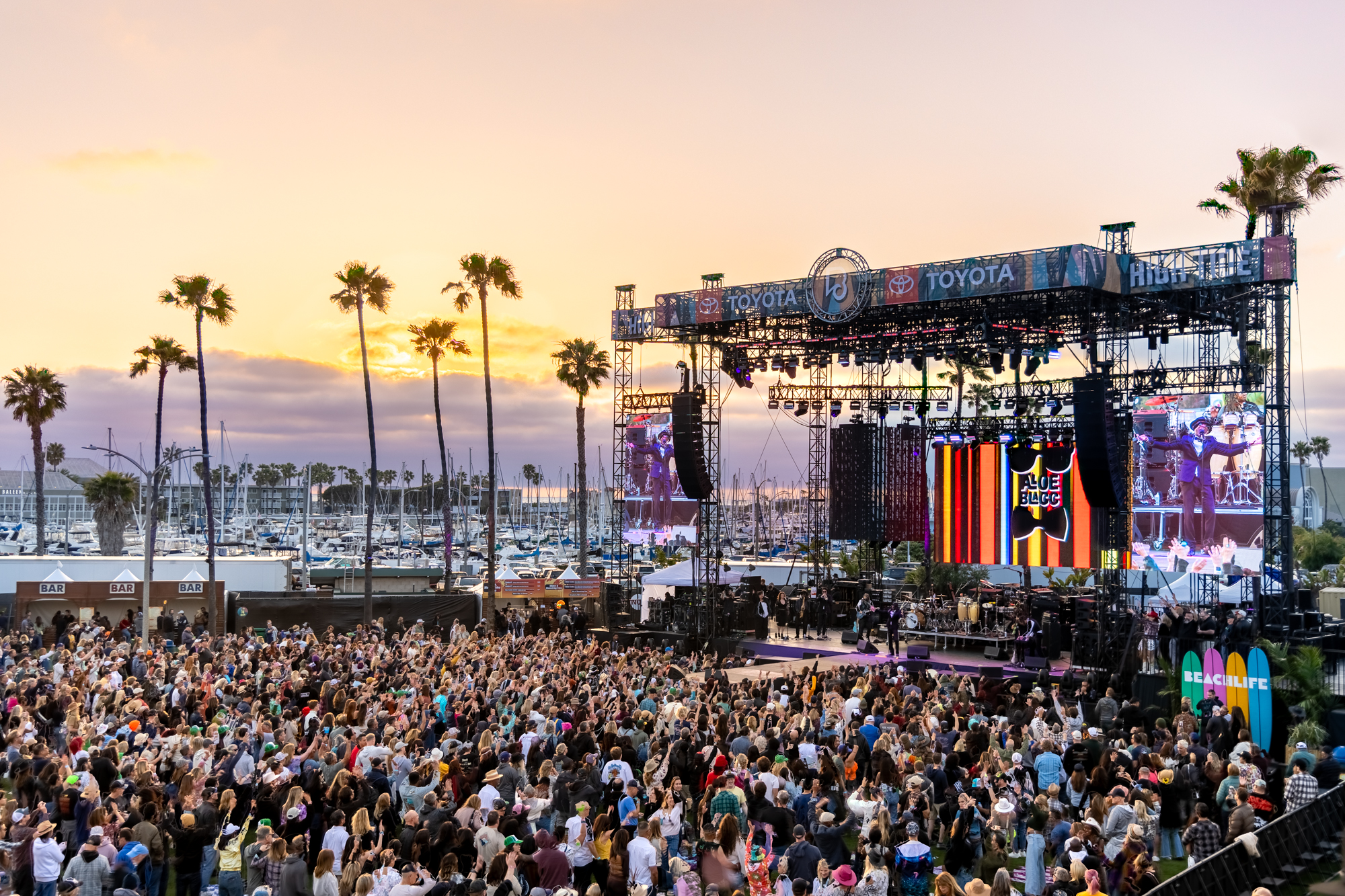
This shabby chic Chateau Marmont setting suits him. The band is here for rehearsals ahead of their appearance on “Jimmy Kimmel Live!,” performing their new song “Free to Love” with special guest Nile Rodgers, an honorary member of the group since his chart-topping remix of their 1984 hit, “The Reflex.” Later this week, they headline BeachLife Festival, then head to Las Vegas for their four-night residency at Bleaulive at the Fontainebleau. The group is rarely far from a stage, with European dates filling up their summer calendar.
With this many performances on the docket, the frothy, funk-spired, feel-good jam is a welcome refresher for the setlist. Nick himself is a frothy, feel-good gentleman. Hospitable and warm, he walks me to the balcony overlooking the Chateau’s grounds, its mature trees bursting with blooms. The al fresco dining area is covered with beige tents, dulling the landscape. “What do we think of these covers?” I ask him. “I kind of hate them.” He doesn’t disagree, saying, “It certainly ruins my view of spying on people while they’re eating.”
Back inside, when we settle on the couch, I notice smudged eyeliner in the corners of his eyes and the faded glow of blush. Are you even in the presence of a member of Duran Duran if there isn’t at least some makeup on their face?
When I first saw them on screen, the visual impact of this band knocked me out. I had never seen humans who looked like them. The group was a lifeline for me after the Islamic Revolution banned music. Their videos and “Top of the Pops” appearances found their way into our home via bootleg Betamax videocassettes taped off the BBC and smuggled into the country. I watched them repeatedly and knew every blink and gesture by heart. These days, when YouTube feeds me classic “Top of the Pops” episodes, I can narrate the movements a split second before they happen.
This is not my first encounter with Nick. From our early interactions more than a decade ago, he’s been friendly and effortlessly polite, his natural refinement and cultured outlook a steadfast calling card. He, and his bandmates, are worldly and thoughtful, perpetually on the cutting edge of new trends and maintaining their decades-long position as trailblazers who are impossible to imitate. It looks like that’s going to hold.
How did “Free to Love” come about?
We wrote it when we were doing the sessions for “Black Moonlight” for Danse Macabre. Nile came up the riff and we were all playing at the time. I remember everyone said, “Oh, this is really cool. It’s too summery, though it’s too uplifting. It’s not for a Halloween album. We need something a little darker and moodier.” But I never forgot this track. I’d shelved it somewhere on ice next to the vodka in the back of my brain. One day I said to the band, “Do you remember that other song that we started? Do you mind if I put it in some kind of shape so we can all listen to it properly?” and they said, “Oh yeah, it was good. Sure, be our guest.” I went into the studio, pieced together a rough, then played it to everyone. They said, “Wow, actually, it’s really great,” and that’s when we started the process of finishing the song and Nile came over to London for the last few things.
My image of Nile has been jolted a little recently, especially after the Billy Idol documentary when he said, “I was a real party animal, be it on the coke or the booze or the what have you… then saying he and Billy were “totally lit” the first time they met David Bowie.
There were times when we were making the Notorious album, I seem to remember half the contents of Bolivia disappearing into the desk. He did really well to pull himself out of it, because he was a little on the wild side. I love Nile. We all do. He’s a natural phenomenon. When he plugs in, he’s like a machine. The guitar becomes part of him. I’ve never, ever seen a more natural musician in my life. He’s just smiling when he’s playing and he’s happy. There isn’t a better living rhythm guitarist that I know of. You think about Nile’s catalog, the people that he’s worked with, he’s peerless, completely.
“Free to Love” is a really fun song.
Well, exactly. That’s what our ethos has always been. Early on, people seemed to say, “Oh, Duran Duran, they write pop songs, great, but they really don’t get involved with different things in the world. They don’t get involved with politics.” Well, no, we’re not politicians, but it doesn’t mean we don’t all have fairly strong political views. We’re not flag wavers. Instead of looking at the doom and gloom and wallowing in it, we did the opposite. We said, “Let’s find a way out.” As time has passed, I think people have realized that. We could have made a nice dark gothic piece—which I love—but people need to smile a little bit. People need to get on the dance floor. It’s too much going on that’s bad. People just need to forget. This is our response to that.
Nick Rhodes.
The video leans into that positivity as well.
I came up with this idea of doing a “Top of the Pops” homage thing. When we first did “Top of the Pops,” we were over the moon. Everybody—all our heroes—had been on it, and that was a real badge of honor. After you’ve done it a dozen times, you think, “We’ve got to go to that studio again and sit there all day.” They didn’t like you leaving—not even if you want to go and buy a sandwich. But now, it’s been gone for so long, we look back and it’s kind of amazing. Here, you had “American Bandstand” and the one I loved most, “Soul Train,” which we played on. I’d never seen that many good dancers in one room. That was fun. We suffused a bit of that into the video. The studio looked just like “Top of the Pops.” Jonas Åkerlund, who directed, got these old cameras so that it looked exactly right. Jonas was the chosen partner by all of us, because he gets detail. He got everything perfect.
It definitely brings back something we know we’re missing.
Lots of people say, “Wouldn’t it be great, even if “Top of the Pops” did just one special a year?” I say, “Who would they put on it? Some kid from a basement with his computer? How’s it going to look? What are they going to do?” We’ve got a bunch of divas that are amazing, but there’s not really many bands or duos or trios. It’s just not like that anymore, is it? Have you seen the “Saturday Night Live” sketch with the DJ? The whole thing is about waiting to press that button. It’s fantastic. The last ones we did were in the ’90s. That was starting then. People would turn up, and they’d just have one keyboard and a laptop or something. For all the angles, people need to be moving around a bit. I’m behind a keyboard. I don’t move very much, pop from one foot to the other. But you need things to move, don’t you? That was what made it fun.
Post Islamic Revolution, bootleg Betamax videos of “Top of the Pops” were a lifeline for us in Iran. I remember seeing Duran Duran videos and thinking I had never seen humans that looked like you five in my life.
You’re not the first person who has said that. We wouldn’t have realized at the time because we couldn’t go to those countries. Fans from Russia, China come to us and say, “We used to get all these tapes.” I’ve got a bunch of them in the archive. I’ve got one from Taiwan and loads from the Philippines.
Are you the keeper of the Duran Duran archive?
Yeah. I got the collecting bug from my dad. I’ve always kept everything and all I end up with is more storage. I’m collecting storage units now. The world’s got enough clutter in it would be one argument. The other one would be, someone’s got to keep some things to remind us what things were. And I guess I’m one of those people. A lot of my friends are complete minimalists. I’m a maximalist. There’s stuff everywhere in my house. It makes life more interesting. I have an obsession with books, mostly picture books. I’ve got more than I could ever read even with the small amount of text in photography books, but I’m never, ever short of something to look at. That’s where a lot of my inspiration comes from.
Duran Duran are trailblazers when it comes to technology. What’s your take on AI in the creative sphere?
What I always feel about new technologies is there’s going to be people that embrace them and think it’s the greatest thing. A lot of people have already become billionaires from becoming the first to create AI platforms and AI businesses. Then there’s people that want to smash up the new machinery and say, “The world is just going mad, and we should not be using this kind of technology. It’s a disaster. Everything’s falling apart.” This has happened with everything. Let’s go back to the Industrial Revolution, when all the workers wanted to smash up the machinery. It’s not really any different, and it won’t be any different in the same way that the machinery never got smashed up. AI is here. The genie is out of the bottle. It does not matter, really, what you think about it or what your position is. Get used to it now.
That doesn’t mean I love everything about it at all. I think it’s utterly despicable that people can take anybody’s material, bands’ songs, stick them into some sausage machine, and then out of the other end comes a song that’s sort of a bit similar to that style of music. Inevitably, some of those songs, eventually, are going to be quite good. It’s a matter of odds, but most of it is utter junk. I’m not pro anybody flooding the market with more junk. We’ve got enough out there already—particularly when it’s junk that’s not even made by people. One of the things I’ve always loved about the arts is that they’re made by real people, for people. The idea of a machine being able to mimic that is, of course, disturbing on one level, in that it takes away some of our unique qualities that we have always treasured as humans. But then, on the other hand, it can be useful. Medical uses already are pretty extraordinary, and it can save a lot of lives. It makes a lot of things faster when you need to find things. The search engines are remarkable now. That side of it I really love. But I’m also curious about what you can do creatively with it.
Would you use AI as an assistive tool to create music?
I have zero intention of asking it to write me a song. But at the same time, what I might be interested in, the same way that I’d be interested in taking a card out of a deck and saying, “Well, if I pick a six, then I’m going to change the key. If I pick a king, I’m going to miss a chorus,” I’m quite curious as to what you can do by using it as a tool. Haven’t done it with songs yet at all. But at some stage, I have no doubt that I will be curious enough to try something.
Regarding visuals, I’ve used it quite a lot. We were the first ones to make an AI video, for “Invisible.” That I was thrilled to do because it really was a challenge. It was at the very beginning of moving AI and video. We had this machine called Huxley. Huxley was trying to make all these things, but for about two days solid, Huxley just made dogs. We couldn’t stop Huxley from making dogs. Some of the dogs look like giraffes and some of them were very Dr. Seuss. It was very uncontrollable at that time.
I made another one for “Danse Macabre,” which was all animation. Again, that was the early stages of the technology. I sat in this room actually, making it with the video guy, Linc [Gasking], who was amazing. We got a lot of things that really work well, but when we found a central character we liked, it wouldn’t repeat the character. Now you can do that with AI, but you couldn’t then. I put in this really detailed description of a gothic horse and stagecoach going through a forest with all the light beams coming in through the window, a gothic girl with a slightly bluish face and big eyes wearing a Victorian dress, with the trees and the shadows coming up. It came back and it looked absolutely amazing, but it had put the carriage in front of the horses. That’s the AI learning process.
But I do think it will be useful. I’ve made visuals for our live show using AI. Some people say, “Maybe you should’ve got an animator to do that instead, or got actors to play these parts.” But it’s different. AI is AI. If you use AI, it literally is a tool. And if you don’t like it, then you don’t use it, do you?
Something I’ve heard repeatedly said by musicians of your generation and those who came before is how you used your inspiration to create something entirely different and new. I’m not feeling that’s the case as much with current day artists.
You’re definitely going to have smart-ass idiots at record labels—of which there are plenty—who can say, “Hey, I’ve got a great idea. Let’s put in Taylor Swift and Billie Eilish and mix it together and see what we get out of AI. Then we’ll get someone to come and sing on top of it.” The industry now, to me, is more cynical than it’s ever been. They may as well be selling biscuits or burgers. They don’t care about the product. There are very few people left in the industry that are anything like the times that I grew up in, or the ’70s when there were real music people. Moguls like Ahmet Ertegun, who really knew what he was doing, and Clive Davis. People that loved songs and knew how to develop artists. People forget that Pink Floyd were signed to EMI and nearly got dropped a couple of times. But there were people there that loved Pink Floyd, and their eighth album was The Dark Side of the Moon. But had they just said, “Oh, your first album didn’t do so well guys, sorry, we’re moving on now,” you wouldn’t have had Pink Floyd.
Now, they don’t really care. They don’t know anything. The people that may as well be selling some kind of domestic product as selling music. There’s no artist relations that are outstanding that I know of. I’m sure someone else is going to want to come and shoot me down in flames and say, “At our label, we have the best team that has found all these people.” But usually, even if you look at some of the success stories, a lot of stuff now is broken out of people doing things themselves online. When did you last hear a story that somebody turned up at a record label, played some demos to them that an A&R guy actually said, “That’s amazing. You come with us. We’ll give you some money. We’ll fund you a little. We’re going to put out your album. We’re going to promote it a bit. We’ll see how it goes.” When did that happen? What they want is something that’s already prepared and boxed up for them, meaning it’s been on reality TV and it won the contest. Then they say, “This is great. We’re going to be so clever. We can stream one million downloads of this in the first two weeks,” which they do, and then two years later, gone, move on to the next one, because no one remembers, and there’s been a lot more TV shows since.
That’s sad to me, because you want generations of kids to have something that their parents don’t like. You want kids to be able to rebel and say, “That’s ours. That belongs to us.” And if what they’ve got at the moment is TV stars that belong to them, that is a shame. Normally, I’m all for progress and life moves on, and isn’t it great, but that one, nah. You need proper artists.
Simon Le Bon.
Longevity is definitely something Duran Duran is enjoying. Do you feel your relationship with your fans has changed over the years?
I think the relationships do change. Some of these fans we’ve known, at this stage, for 30-something years. You can’t help but have a fondness and an admiration for them for sticking around for that long and for supporting us. I think any artist that does not recognize that they’re still there because of their fans is a fool. That’s what we attribute everything to. We’re enormously grateful, and I really mean it. It’s enabled us to do what we do. If we got to the point where we had to self-fund everything and nobody ever bought our records or came to any of our shows, it would have been a lot harder. The thing we’ve been most blessed with as a band that is around for more than several decades is you crossover generations. A lot of that is our fans getting their kids involved or introducing it to the neighbor who’s half their age. When I look out at the audience, I literally see everyone from tiny little kids that were, for sure, probably only born when we put the last album, all the way through to people that are our age, and possibly even a little older, and that’s kind of great.
With all your accomplishments and achievements, is there any box left unticked? Your default venue in Los Angeles is the Hollywood Bowl. Where do you go from there?
I mean, I do love that. But just when you think there isn’t something, there’s always things left. For the last decade, on and off, at different times, we’ve been looking at a Duran Duran movie. I don’t want to just do a straightforward biopic. I’m sure some of them are fine, but it doesn’t feel right to me. I think we should do it differently. So we’re looking at ways to maybe do that. People have been talking about a musical for about 15 years. Again, I don’t really like those songbook things, a jukebox where you just go through everything. We’re considering doing a theater piece in New York, which we haven’t signed off on yet. It’s dance but it’d be very modern and we’d work with the interesting people on it. I think that’s actually quite exciting. There’s lots of things like that that you always look at, and they’re not all going to land. The people that did ABBA Voyage, they’d approached us to talk about something. I went to see it. It is pretty remarkable. The technology has moved so much further now. But then, of course, there’s writing more songs, playing different kinds of venues. As we move forward, I have to say, I do have slightly less interest in just continuing playing exactly the same venues. But then, how do you ever get bored with the Hollywood Bowl or Madison Square Garden?
To see our running list of the top 100 greatest rock stars of all time, click here.